Private acquisition opportunity · Kelowna, British Columbia
Kestrel Climate Systems
Heating, cooling and refrigeration for the Central Okanagan since 2009.
Listing SM-0217 · Version 1.0 · Prepared August 2026 · Fictional demonstration
Explore the opportunity
01
01Opportunity
Seventeen years of proof, ready for its next owner
Kestrel Climate Systems is a twelve person heating, cooling and refrigeration company serving about 250,000 people across Kelowna, West Kelowna, Lake Country, Peachland and Summerland. In 2025 it billed $2,580,000, earned $489,300 for one working owner, and renewed 96% of its commercial maintenance contracts. The owner is retiring; the systems, the team and the customer base are built to keep running through a change of hands.
Asking price
$1,549,000
3.2x SDE4.1x the EBITDA reference of $379,300
Revenue, 2025$2,580,000
Reported operating profit$315,300
Seller's discretionary earnings$489,300
SDE margin19.0%
Seller's discretionary earnings, the $489,300 above, is everything the business paid its one working owner in 2025: profit, salary and benefits together. The asking price is 3.2 times that. The EBITDA reference imagines a hired general manager running the business instead: after a market rate manager at $110,000, $379,300 of profit remains, and the price is 4.1 times that number.
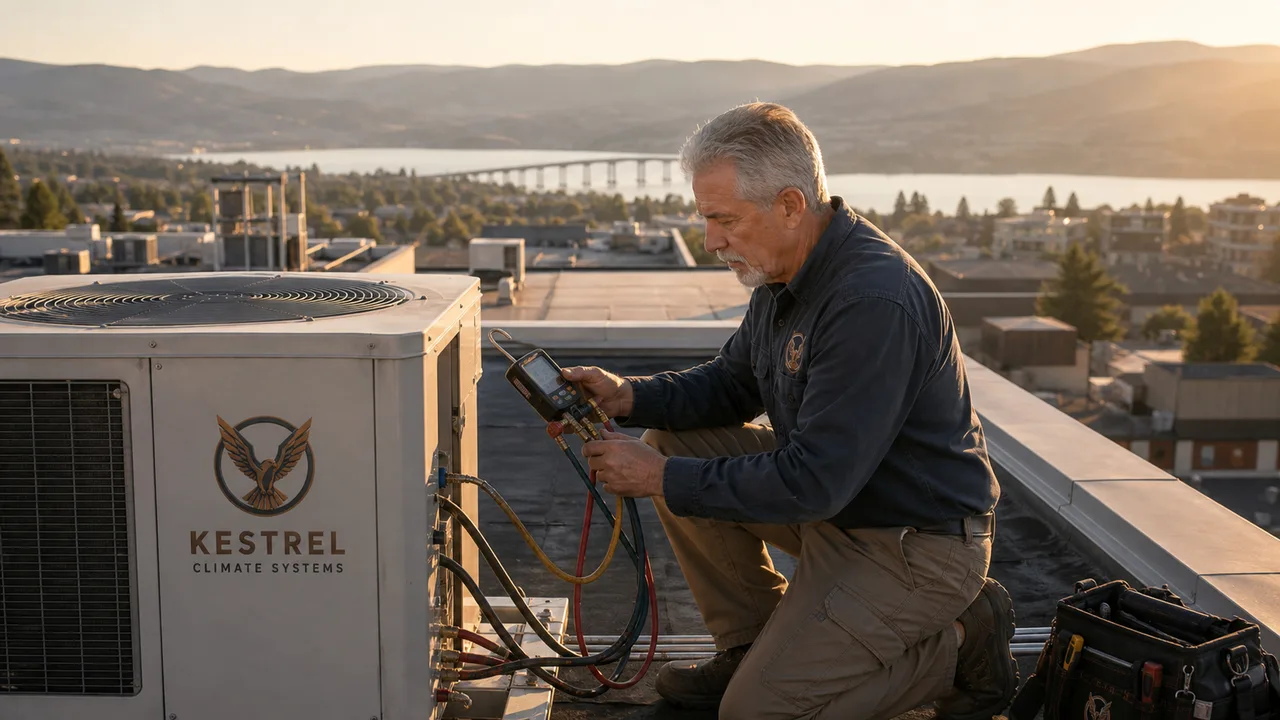
Late day service above Okanagan Lake
Six reasons this deserves a serious look
Each one is a fact from the record, not a promise about the future.
A replacement market, not an adoption bet
About 95% of Kelowna homes are already air conditioned and 81% were built before 2011: the installed base ages on a schedule no economy changes much.
95%homes already cooled
Recurring relationships, honestly labelled
52 commercial contracts renewing at 96% and 240 memberships at 89%, worth about $320,000 a year, steady through the slow months of spring and fall.
292agreements renewing
Two real seasons, not one
Heating and cooling both peak here, so the strongest month runs just 1.78x the weakest: no boom and bust.
1.78xstrongest month vs weakest
Margins beside the filed data
Gross margin of 45.2% and operating margin of 12.2% sit in the healthy band CRA filed BC returns show for this trade.
45.2%gross margin, 2025
Scale most competitors never reach
About 80 area contractors, most running one or two trucks. Kestrel runs seven vehicles and twelve people on documented checklists.
80area competitors
A team that carries its licences
Average tenure of 7.9 years, and the Service Manager's Red Seal refrigeration and Class B gas tickets keep both company licences workable through a sale.
7.9 yrsaverage tenure
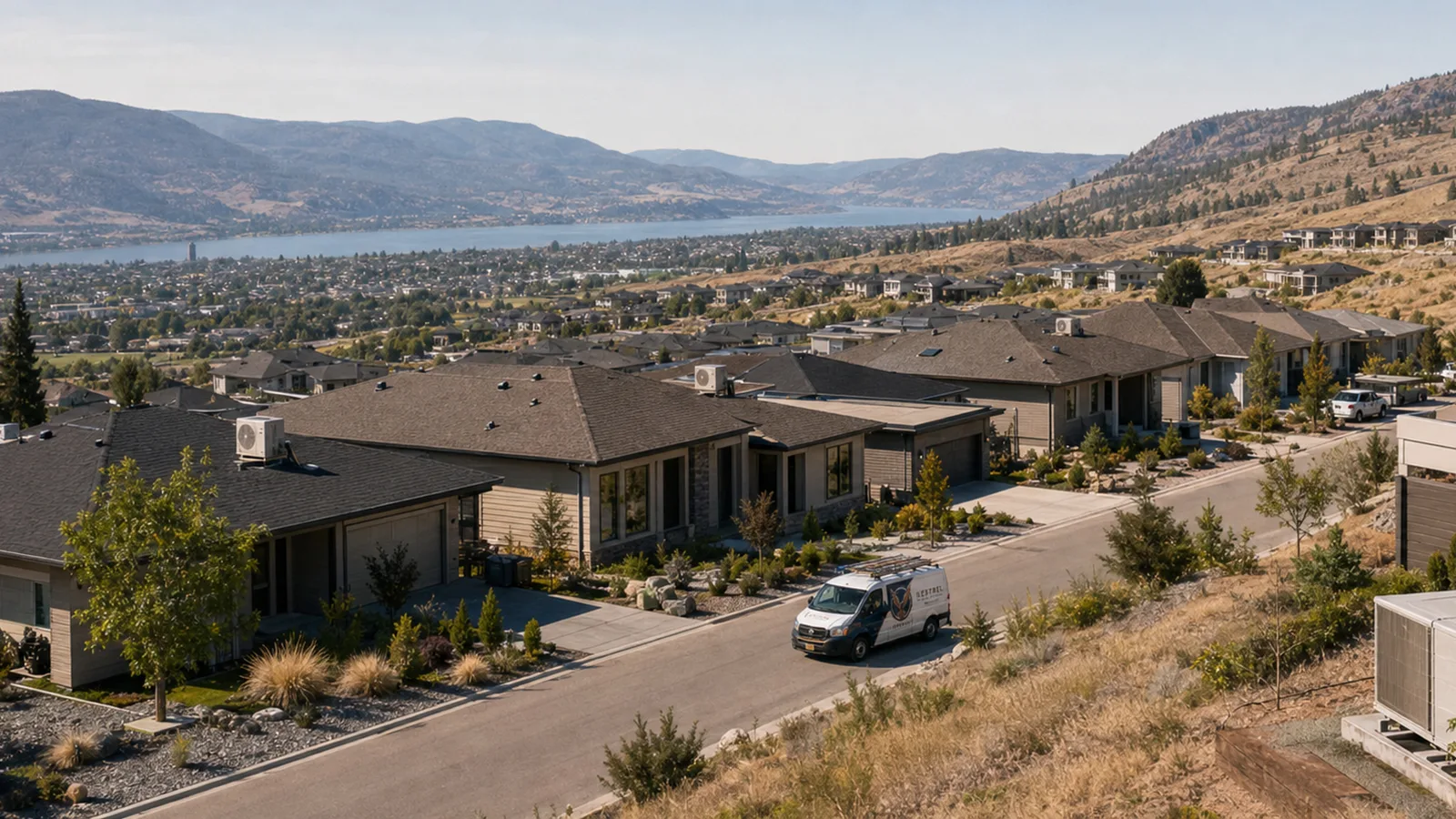
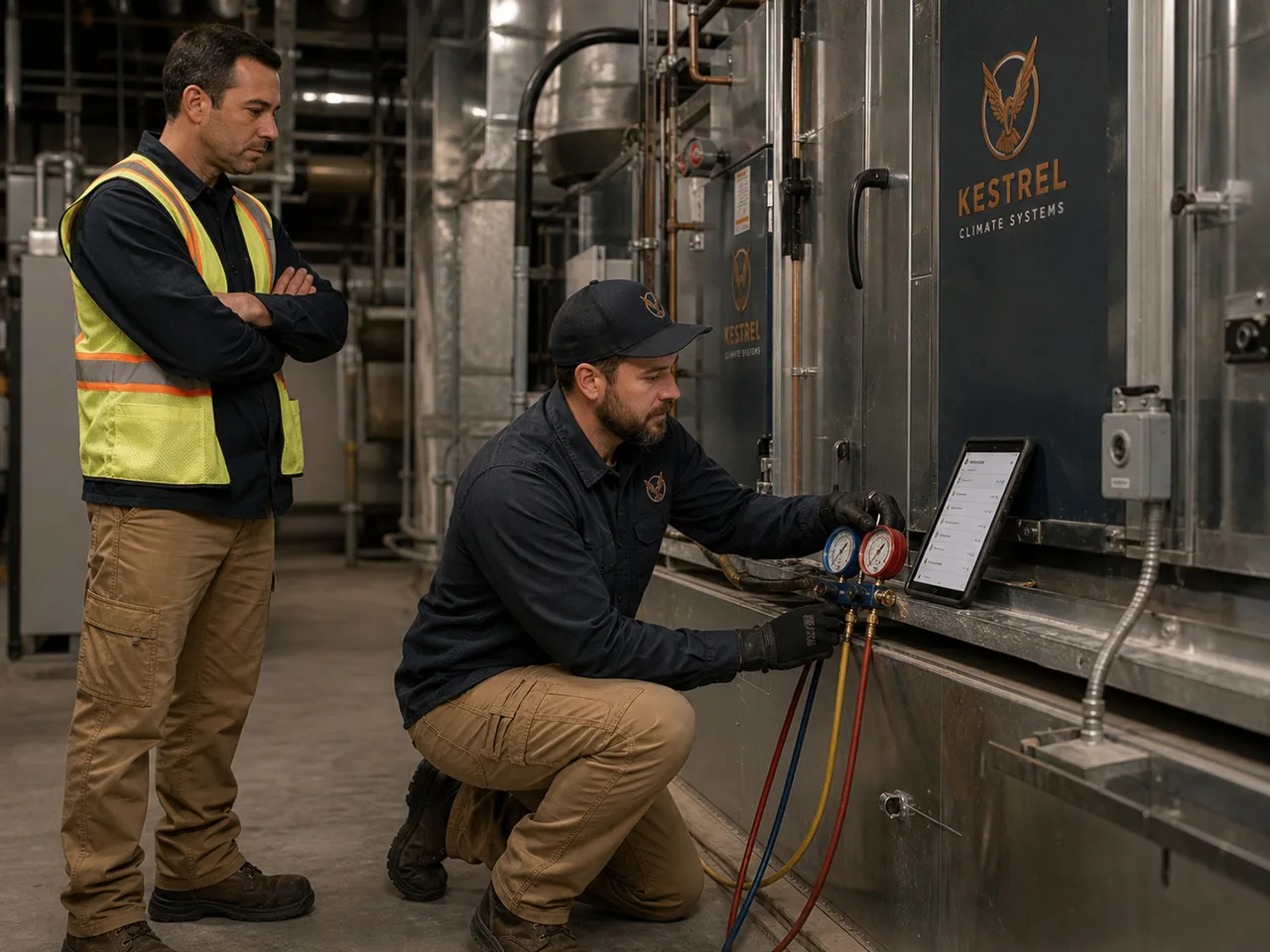
The installed base, street by streetCommissioning, measured not guessed
How the deal is framed
Sale structureProposed
Asset sale of the operating business, with a share sale open to discussion.
Reason for sale
Planned retirement and relocation to Vancouver Island. No health or distress factors.
Timing
The owner is available for a closing 60 to 90 days after an accepted offer.
Transition supportProposed
Eight weeks full time, then advisory support to month six.
Financing shapeOpen to discussion
Typical for this size: bank or BDC term financing, with 10 to 15% of the price carried by the seller.
What the price buys
Included in the price
Fleet of 7 vehicles
Equipment and tools
Inventory at cost up to $60,000
Maintenance membership base, commercial contracts and customer records
Phone numbers, domains, website and systems
Trade name and goodwill
Not included
Cash and accounts receivable
Accounts payable and pre-closing liabilities
The Owner's personal effects; the pickup is included
Vehicle loan (about $18,400) cleared by the seller at closing
Proposed allocation of $1,549,000
Vehicles$255,000
Equipment and tools$82,000
Inventory$58,200
Goodwill and intangibles$1,153,800
Proposed allocation only; subject to agreement and tax advice.
The proof keeps going
Every number on this page has a section behind it. Keep reading.
How demand becomes routed work, done and collected
A dispatch led service operation: 2,050 service calls, 138 installations and replacements, 688 maintenance visits and 310 air quality and duct jobs in 2025, run from a 4,800 square foot shop by twelve people and seven vehicles.
Booked field hours, 2025
8,900
74%utilization
Utilization across the field team, on the hours the dispatch board actually booked.
Service calls2,050
Installations and replacements138
Maintenance visits688
Air quality and duct jobs310
Vehicles in operation7
Active maintenance agreementsdetailed under Customers292
Monday to Friday, 7:30 to 4:30, with an on call rotation after hours and Saturday maintenance blitzes through spring and fall.
Average tickets derived from these counts sit inside published Canadian ranges: service about $466, installations about $8,400 across furnaces, cooling and heat pumps, air quality work about $465. After hours demand runs about 10 to 14% of inbound calls, in line with measured industry data.
One flow, first ring to renewal
Every job moves through the same seven stages. Select a stage for who runs it, the system behind it, and the one thing a buyer should watch.
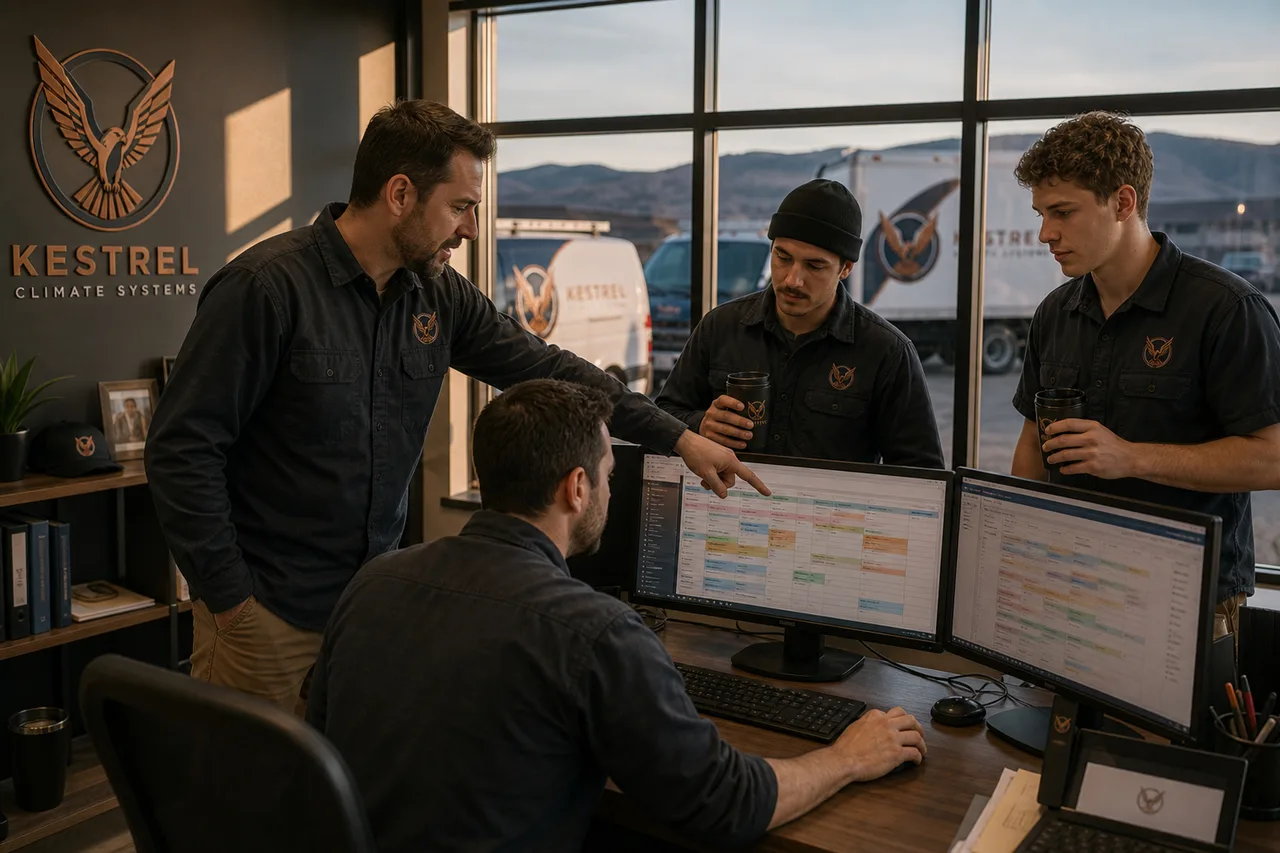
The 7:20 board, where the day is routed
Every job starts at the desk: the dispatcher answers the call, takes the details, and either books a service visit straight into Jobber or opens a quote request for the advisor.
Who runs it
Customer Service and Dispatch
System
Jobber and phones
Typical timing
Same day
Principal output
Booked call or quote request
Owner involvement
None
Watch point
Single CSR; Office Manager covers breaks
Small work is priced on the spot by the technician. Replacement work gets the Comfort Advisor's in-home visit and a written quote inside 48 hours; only installs over $15,000 wait on the owner's pricing.
Who runs it
Comfort Advisor; techs quote small work on site
System
Jobber quotes
Typical timing
Replacement quotes within 48 hours
Principal output
Signed quote
Owner involvement
Final pricing on installs over $15,000
Watch point
Commercial pricing playbook lives with the Owner
The dispatcher builds each day on the Jobber board: service calls slotted one to three days out, installs booked one to three weeks ahead, and a documented triage protocol for the summer heat waves.
The crews run the day from Jobber mobile with checklists on every job, photograph the finished work, and pull in crane or sheet metal subcontractors where a job needs them.
Who runs it
Technicians and install crew
System
Jobber mobile, checklists
Typical timing
Service same day; installs 1 to 2 days
Principal output
Completed work with photos
Owner involvement
None
Watch point
Crane and sheet-metal subs booked per job
The Service Manager reviews every completed checklist inside a day and either closes the job or books the callback. The callback rate is tracked monthly and sat at 2.1% in 2025.
Who runs it
Service Manager
System
Checklist review and callbacks log
Typical timing
Within 24 hours
Principal output
Closed job or callback
Owner involvement
Escalations only
Watch point
Callback rate tracked monthly, 2.1% in 2025
Invoices go out on completion through the Jobber to QuickBooks sync, installs collect a deposit up front, and commercial accounts run on net 30.
Who runs it
Office Manager
System
Jobber to QuickBooks sync
Typical timing
Invoice on completion; deposits on installs
Principal output
Paid invoice
Owner involvement
None
Watch point
Commercial accounts on net 30
Seasonal maintenance reminders go out from Jobber and come back as booked visits. The renewal outreach cadence is the one piece not yet written down.
Who runs it
Customer Service and Dispatch
System
Jobber reminders
Typical timing
Maintenance reminders seasonal
Principal output
Booked maintenance or renewal
Owner involvement
None
Watch point
Renewal outreach cadence not yet written down
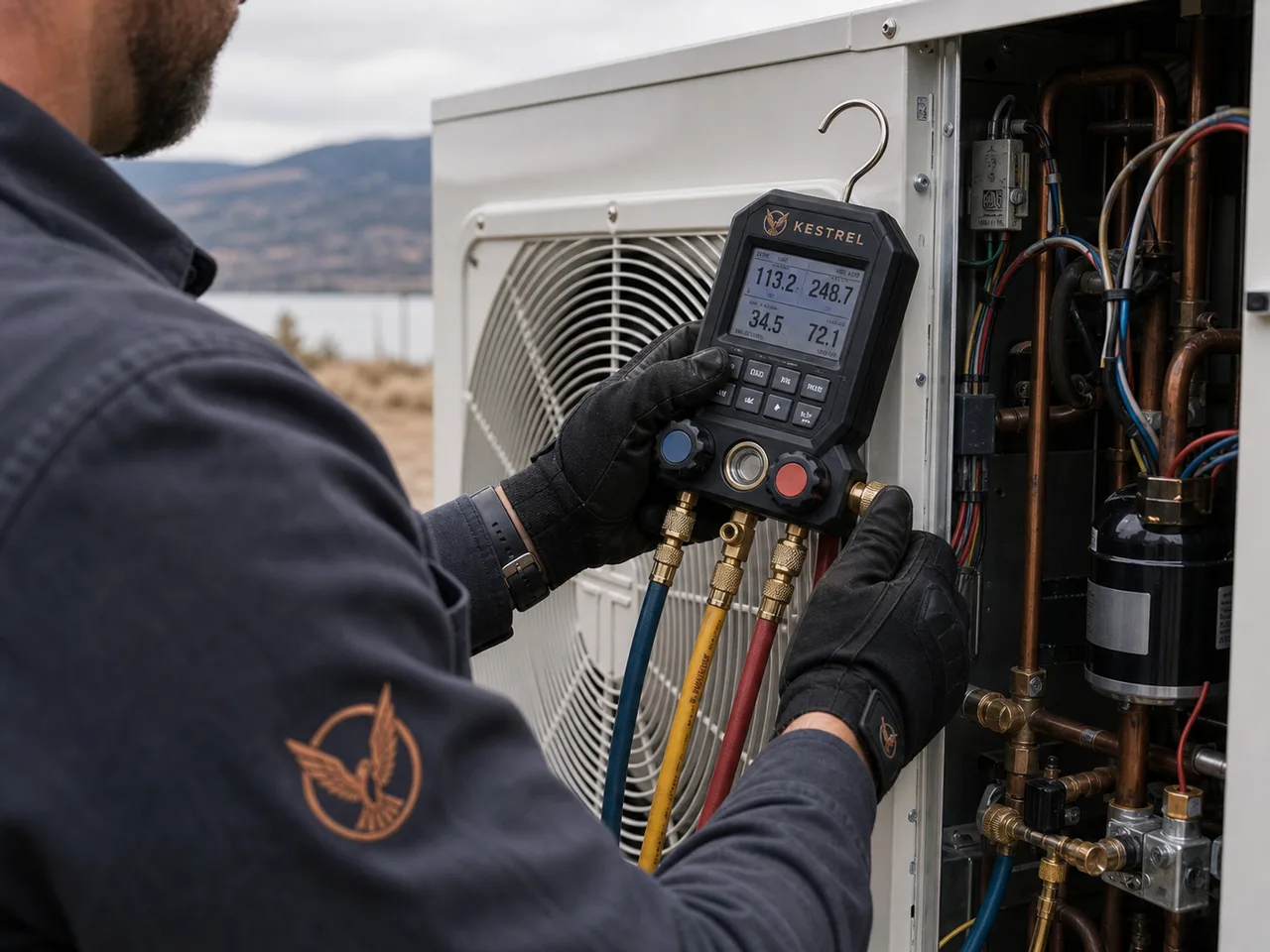
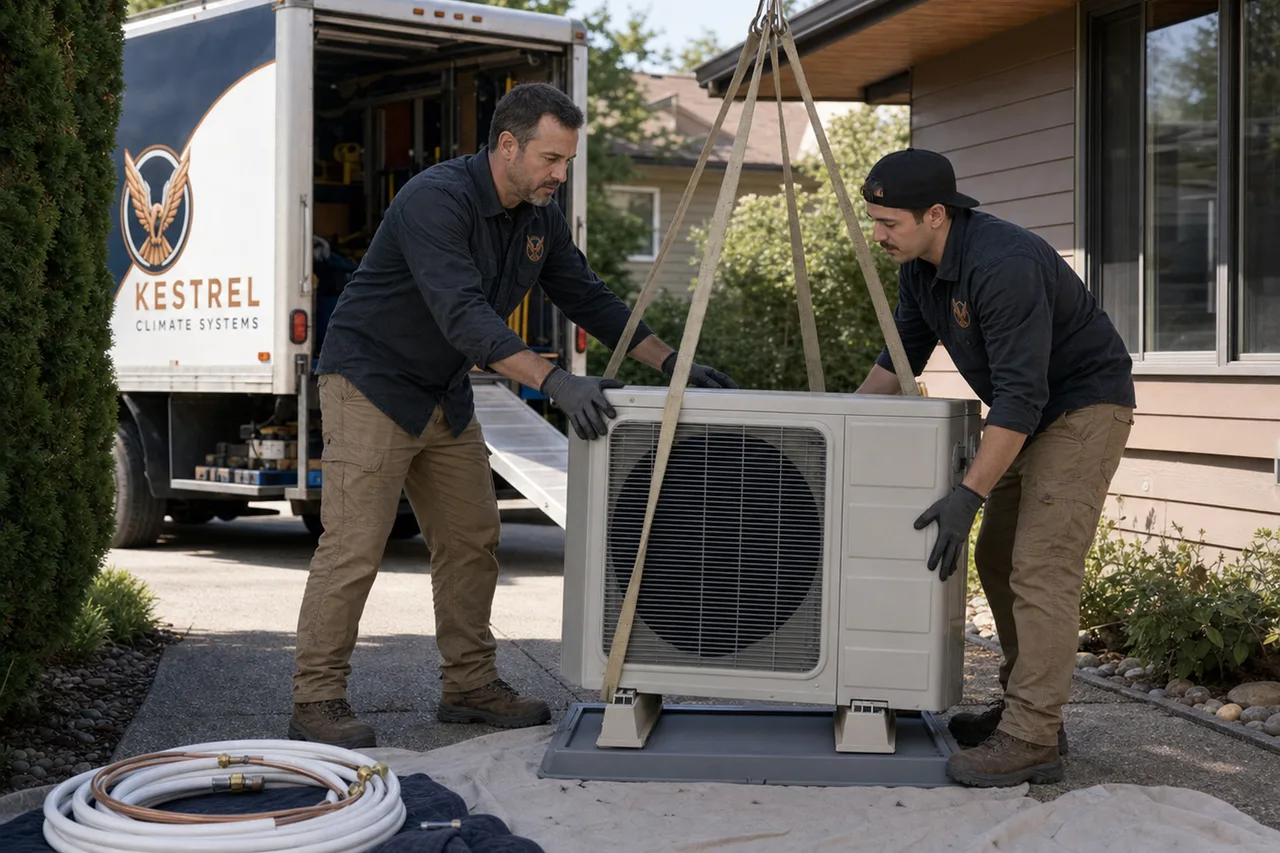
Field work: an air conditioning changeout, done tidily
The layers underneath
01Systems and what they costSeven systems, $18,900 a year all in
System
Main users
Cost a year
Contract
Transfer
JobberField service management: booking, dispatch, quotes, invoicing
All staff
$4,700
Annual plan, billed in US dollars
Account transfer supported; admin handover at closing
QuickBooks OnlineAccounting
Office Manager, Owner, accountant
$1,320
Monthly
Transferable with books; accountant retains working papers
PayworksPayroll
Office Manager
$2,210
Per run
New account or transfer; either works
Google WorkspaceEmail, calendars, drive
All staff
$2,030
Annual
Domain and accounts transfer with the business
Geotab GPSFleet tracking
Service Manager
$4,560
36-month, ends 2027-05
Assignment with provider consent
Website, domains and review platformkestrelclimate.ca (fictional), Google Business Profile, review requests
Office
$2,900
Annual hosting
Domains and profiles transfer with the business
Load calculation softwareHeat loss and equipment sizing
Comfort Advisor
$1,180
Annual licence
Licence reassignment
02Procedures, and where they liveWhat is written down, what is still in heads
Dispatch and triage protocolDocumented
Install and commissioning checklistsDocumented
Maintenance visit checklistsDocumented
Safety program and toolbox talksDocumented
Refrigerant handling logs and approved-person registerDocumentedKept 36 months as required
The commercial pricing playbook and the membership renewal cadence are the two items the transition plan writes down with the buyer in the first 90 days.
03Owner involvement, honestly drawnWhat needs the owner, what does not
Runs without the owner
Booking, dispatch, field work, quality control, invoicing and collections run day to day under the Service Manager and the office team.
Held by the owner today
Final pricing on installations over $15,000, the top 20 commercial relationships, and the commercial contract pricing playbook.
The cover in place
The Service Manager can assume dispatch and quality control immediately, holds Class B gas qualification, and is the named refrigeration mechanic, which keeps both company licences workable after a sale.
Daily operating independence is real; strategic pricing and key commercial relationships are the owner dependency, and the eight week transition plan is built around exactly those.
04Assets, vehicles and inventory$255,000 fleet, $82,000 equipment, $58,200 inventory
Unit
Use
Estimated value
Status
2024 Ford Transit 250 high roof
Service
$52,000
Owned
2022 Ram ProMaster 2500
Service
$36,500
Financed; about $18,400 cleared at closing
2021 Ford Transit 250
Service
$33,500
Owned
2019 Ford Transit 250
Service
$24,000
Owned
2018 Chevrolet Express 2500
Service and shuttle
$17,500
Owned
2020 Isuzu NPR box truck
Installations
$52,000
Owned
2021 Ford F-150
Owner and quotes
$39,500
Owned
Fleet and equipment are owner-estimated fair values set against current market listings and street prices (not distributor list prices, which run about double); inventory at cost from the count of March 2026; none independently appraised. The balance sheet carries depreciated book values, shown separately. Included in the sale: the fleet, equipment and tools, and inventory at cost up to $60,000. The one financed vehicle is cleared by the seller at closing.
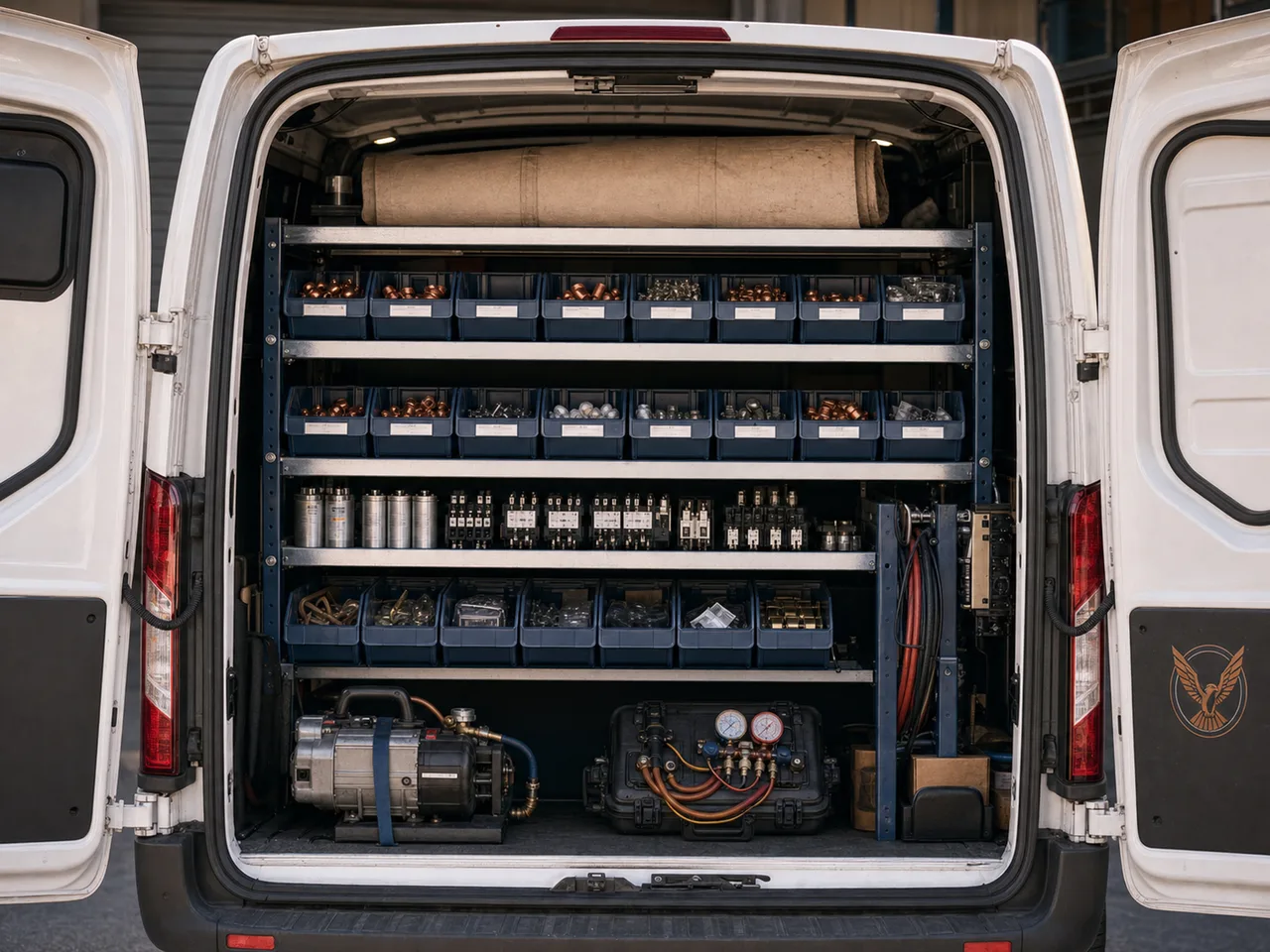
A shelved van is a run businessEquipment and tools, $82,000
Refrigerant recovery stations (2)$14,000
Brazing and pipe sets$12,500
Vacuum and charging equipment$9,600
Sheet metal tools and brake$9,800
Combustion analyzers and diagnostics$7,800
Press tool system$6,800
Ladders and access equipment$6,400
Shop compressor and air lines$5,200
Shop racking and benches$4,600
Test instruments$3,000
Shared hand tool pool$2,300
Inventory at cost
Equipment units$31,400
Parts$19,300
Refrigerant and consumables$7,500
Total, count of March 2026$58,200
05Premises and lease4,800 sq ft, six bays, leased to October 2027 with a five year option
The space
Six bays, mezzanine parts storage, eight yard stalls, front office and showroom corner. About 4,800 square feet in the Rutland light industrial area.
The money
Base rent $6,500 a month plus about $2,150 in additional occupancy costs: 16.25 and 5.38 dollars per square foot. Stepped from $6,200 in January 2025; the option period reprices at market.
The term
Expires October 31, 2027, with one five year renewal option at market rates.
On a sale
Assignment and change of control require landlord consent, not to be unreasonably withheld. Third party consent required
Kelowna industrial asked a weighted average of $15.43 per sq ft net at year-end 2025 (Rutland North $17.39); measured additional rents run $5.25 to $6.00. The lease sits on market.
06Suppliers and dependenciesLargest supplier carries 41% of materials, with substitutes in market
Volume pricing tier; transfers with a consent letter; two comparable distributors in market
Coastal HVAC Parts (fictional)
22%
Net 30
Parts and motors; no exclusivity
Pacific Refrigerant Services (fictional)
8%
COD to Net 15
Refrigerant supply and recovery cylinders
Various
29%
Mixed
Sheet metal stock, controls, sundries
07Licensing, safety and complianceBoth trade licences current; zero lost time claims in five years
Requirement
Held by
Standing
On a sale
Gas contractor licence (Technical Safety BC)
Company. Gas needs no named field safety representative; the company must ensure staff who sign inspections or supervise are licensed gas fitters
Annual renewal, current
On an asset sale the buyer establishes its own licence and $10,000 surety bond before closing; on a share sale the licence continues
Surety bond, $10,000 (obligee: British Columbia Safety Authority)
Company, through its insurer
Continuous; lapse suspends the licence
Buyer posts its own bond on an asset sale; bond rider on a name change
Refrigeration contractor licence, BPVR Class REF (Technical Safety BC)
Company; the Service Manager is the named refrigeration mechanic and quality control manager (QC program mandatory since January 2026)
Annual renewal, current
Asset sale: new licence, QC program and named mechanic (the Service Manager qualifies); share sale: continues with an update filing
Gas fitter certificates of qualification
Owner Class A; Service Manager Class B (GP); two technicians Class B (3-year renewal cycle each)
Current
Held personally; travel with the people
Refrigerant handling (approved persons under the BC ODS regulation)
All service technicians; employer keeps the approved-person register and 36-month service logs
Current
Registers and logs transfer with the records
City of Kelowna business licence
Company
Annual, current
Reissued to buyer on application
Commercial general liability, $5,000,000
Company
Renews March
Buyer places own policy at closing
Fleet and equipment insurance
Company
Renews March
Buyer places own policy
WorkSafeBC account, classification unit 721043
Company
In good standing; clearance letter available
Asset sale: buyer registers fresh at the base rate; share sale: the account and its experience rating continue
Written safety program, monthly toolbox talks, zero lost-time claims in the last five years; the clean record earns an experience-rating discount below the classification base rate
03
03Customers
A customer base built one service call at a time
Most of this work arrives by phone: a furnace out, a cooling season starting, about 168 leads in an average month. Answered well since 2009, those calls have become 1,940 active customers. An active customer is one billed at least once in the trailing 24 months, counted at December 31, 2025.
Where the work begins
The phone rings first
Nearly nine in ten active customers hold no contract at all: they call when a furnace quits or a cooling season starts, and that demand work is the core of the business. The layer that comes back on its own follows further down.
Retention, at the front door
Leads in an average month
168
Marketing spend, 2025
$86,000
Blended acquisition cost
$168
These are the assumptions the Forecasts section lets a buyer change: spend, cost per customer, and what a won customer is worth.
How they find the companyshares are of leads
Paid search and Local Services Ads38%
Organic search and maps24%
Referrals21%
Yard signs and home shows9%
Other8%
58%of quoted work becomes a job41%of replacement quotes close512new customers won in 2025
Who those calls become
Seventeen years of answered calls, counted honestly. 45% of 2025 revenue walked in new; the rest came from people and buildings that had called before.
Active customers
1,940
55% repeat45% new
Shares of 2025 revenue. Repeat means memberships, contracts and customers who simply call again; it is never blended with contracted revenue alone.
Average per active customer2025 revenue over active customers, rounded$1,330
Customer mix, three segments
Residential1,513
Commercial272
Property management and strata155
Residential carries the count; commercial and property management carry weight per customer. Hover a row for all three measures.Tap a row for all three measures.
The commercial book is real work, in real plant rooms
Two kinds of recurring revenue, kept apart on purpose
About 12% of active customers hold a membership and most customers hold neither: they call when something needs fixing, and that demand work is the core of the business. The two recurring families below are different instruments and are never added into one number.
Commercial maintenance contracts
52$248,000 a year
96%renew
Binding annual agreements with buildings: quarterly maintenance, filters, priority response and an agreed rate card.
About $397 per site per month, billed monthly or quarterly by contract.
$4,769 average revenue per site a year; cancellation 4%.
About $299 a year for two visits (furnace tune up in fall, cooling in spring), priority scheduling and a 15% repair discount.
Payable monthly when the customer prefers; nobody visits monthly. Homeowners can cancel, and 11% do.
Standard for the trade: comparable Kelowna plans run $219 to $510 a year, so this one sits mid range.
Memberships transfer with the business.
Grew 195 to 240 across three years
The largest single relationships
A homeowner never appears on this list: residential revenue arrives as a crowd, in small pieces. One property manager, though, holds forty buildings behind a single phone number, which is how one relationship can be worth $118,700 a year. Even that one carries just 4.6% of 2025 revenue.
RelationshipRetention watch2025 revenue
Property management firm, 40 buildings12 years · Commercial maintenance contracts and service · Annual, renews March
Retention watchRenewal March 2027; 96% commercial renewal history$118,700
Strata corporation, 3 towers8 years · Quarterly maintenance and service · Annual
Retention watchLow$62,400
Mechanical general contractor6 years · Overflow install labour and service · Per project
Retention watchProject-based; varies$48,500
Retail chain, 3 locations9 years · Maintenance contract and refrigeration service · Annual
Retention watchLow$44,200
Seniors residence7 years · Maintenance contract, priority service · Annual
Retention watchLow$41,300
Largest customer4.6%
Top five together12.2%
Top ten together18.3%
Everyone else81.7%
Economics, collection and the honest risks
Receivables, December 31, 2025
$118,400
Current $72,30031 to 60 $28,60061 to 90 $11,20090 plus $6,300
Residential collects in about 24 days; commercial accounts run net 30 and collect in about 38.
Churn, replaced with room to spare
About 6% of prior year active customers did not return in 2025: roughly $96,000 of 2024 revenue that did not repeat, more than replaced by 512 new customers.
Contract expiry exposure
The largest customer (4.6% of revenue) renews in March 2027 on a 12 year relationship and a 96% commercial renewal history. Week one of transition introduces the buyer.
04
04Team
Twelve people, and the trade tickets to keep both licences alive
Average tenure of 7.9 years across a Service Manager of nine years, four service technicians, an installation lead, an apprentice who runs the maintenance route, and a three person office plus a part-time bookkeeper. Employees have not been told about the potential sale; continuity below is labelled honestly, never promised.
The crew, at the end of a summer day
The crew, in numbers
Who does the work, what they hold, and what the whole workforce costs.
People
12
10 full time, 1 part time, plus the owner
Average tenure7.9 yrs
Total workforce cost, 2025reconciled below, line by line$859,400
Open positionsone service technician posting, open since June 20261
Tickets on staffOwner holds Class A gas. The Service Manager holds Red Seal refrigeration and Class B gas and is the named refrigeration mechanic. Two technicians hold Class B gas, and every service technician is an approved refrigerant person.
Contractorscrane and sheet metal subcontractors booked per job; no standing contractor roles
The field
Service Manager
9 yrs
What they do
Runs the service side day to day: assigns and dispatches every call, sets the quality bar and signs off on completed work, and takes the escalation when a job goes sideways. Named refrigeration mechanic on the company licence, so the tickets stay alive without the owner.
Services performed
Dispatch and schedulingQuality controlEscalationsLicence coverage
Qualifications
Red Seal Refrigeration and AC Mechanic; Class B gas fitter (GP); named refrigeration mechanic on the company's refrigeration licence and quality control manager
Pay, 2025
$88,000
Senior Service Technician
12 yrs
What they do
The strongest diagnostician in the company: takes the hardest service calls, the intermittent faults and the commercial refrigeration work the other technicians hand up. Mentors the apprentice at the bench.
Age 61; retirement possible within 2 to 3 years. The apprentice pipeline and the open posting are the plan.
Service Technician
7 yrs
What they do
Runs a full residential and light commercial service day: heating and cooling repairs, gas work under the Class B ticket, and maintenance visits between calls.
Services performed
Service and repair callsGas fittingMaintenance visits
Qualifications
Class B gas fitter
Pay, 2025
$71,000
Service Technician
5 yrs
What they do
Carries the same service load: repairs, gas work under the Class B ticket, and the seasonal maintenance push in spring and fall.
Services performed
Service and repair callsGas fittingSeasonal maintenance
Qualifications
Class B gas fitter
Pay, 2025
$66,500
Service Technician
3 yrs
What they do
Service calls and maintenance work while progressing through the refrigeration apprenticeship pathway; picks up installation support in spring and fall.
Services performed
Service callsMaintenance visitsInstall support
Qualifications
Refrigeration apprentice pathway
Pay, 2025
$58,000
Installation Lead
11 yrs
What they do
Leads the two person install crew through every changeout and new installation: sheet metal fabrication, setting the equipment, commissioning, and the final walkthrough with the customer.
Services performed
InstallationsSheet metal fabricationCommissioningCustomer walkthroughs
Qualifications
Sheet metal and install specialist
Pay, 2025
$69,000
Apprentice (Level 2)
1 yr
What they do
Runs the maintenance visit route through spring and fall and rides with the senior technician the rest of the year, building toward the refrigeration ticket.
Services performed
Maintenance routeInstall assistsShop support
Qualifications
HVAC apprenticeship
Pay, 2025
$30,400. Partial year from the May 2025 hire; annualized about $47,000
The office
Office Manager
14 yrs
What they do
Keeps the money moving: enters the books, chases receivables, runs payroll every cycle, and covers the phones when the dispatcher steps away.
The voice of the company: answers every inbound call, books the work into Jobber, and routes the day for the field crew.
Services performed
Inbound callsBookingRouting and dispatch
Pay, 2025
$49,500
Watch point
Single person on the desk; the Office Manager covers breaks and holidays.
Comfort Advisor (estimator)
6 yrs
What they do
Runs residential replacement sales end to end: the in-home visit, load sizing, the quote and the follow-up. Compensation includes commission on closed installations.
Services performed
In-home sales visitsLoad sizing and quotesFollow-ups
Pay, 2025
$58,500
Part-time bookkeeping (Owner's spouse)
15 yrs
What they do
Month end reconciliations and oversight of the books behind the Office Manager's entry work.
Services performed
Month endReconciliations
Pay, 2025
$28,000
Watch point
About $10,000 of market rate work; the premium is an SDE add-back and the function is replaceable by an outside bookkeeper. Ends at closing.
What the workforce costs, tied to the statements
Field wages and employer burdenSits inside direct costs on the income statement$507,600
Office and administrative payrollInside operating expenses$196,000
Owner salaryAdded back in the SDE bridge$96,000
Employer costs, office and ownerCPP, EI and WorkSafeBC$31,000
Extended health benefits, all staff$28,800
Total workforce cost, 2025$859,400
Field labour includes field wages plus employer burden and sits inside direct costs; the remaining lines sit inside operating expenses. Owner compensation is added back in the SDE bridge under Financials. BC Employer Health Tax is nil with payroll under the $1,000,000 exemption. Under BC employment standards, employment generally continues through a sale of the business, so tenure and its entitlements carry to the buyer. Buyer due diligence required
The office engine
Succession, taught at the bench
Continuity after a sale, with honest labels
Employees have not been told about the potential sale. Nothing below is a commitment by any employee.
Service Manager
12-year relationship, second gas qualification, named on the refrigeration licence; no stated plans to leave; no written commitment
Expected
Field team overall
Employees have not been told about the potential sale
Not Yet Discussed
Senior Service Technician
Age 61; apprentice pipeline and open posting are the plan
Uncertain
Owner's spouse bookkeeping
Replaced by outside bookkeeper at about $10,000 per year
Ends at closing
Owner
8 weeks full-time included, then advisory support; see transition
Proposed
What the owner still holds
Final pricing on installations over $15,000, the top 20 commercial relationships, and the commercial pricing playbook. The eight week transition is built around handing exactly these over.
The cover already inside
The Service Manager can assume dispatch and quality control immediately and keeps both company licences workable. The apprentice pipeline and the open posting are the plan for the senior technician, 61, who may retire within two to three years.
The wage truth, stated
Field wages sit modestly below Thompson Okanagan medians (Red Seal about $83,000, gas fitter about $87,000). Tenure and the benefits plan carry retention today; a buyer should budget for wage reviews, and the Forecasts section carries a wage growth driver for exactly this.
05
05Financials
Three years, every figure tied to the statements
The three-year record first, then every line of the statements, then how the profit the statements report becomes what an owner takes out. Every figure below comes from the compiled statements and adds up to the dollar.
The record, fiscal 2023 to 2025
Every year ahead of the last
Revenue grew 10.8% in 2024 and 12.6% in 2025. Seller's discretionary earnings, what one working owner takes out, grew 26.5% from 2023 to 2025, and gross margin, what the work keeps after equipment and crews are paid, went from 44.2% to 45.2%. Every total on this page ties to the compiled statements to the dollar.
Revenue, fiscal 2025up 24.8% from 2023 to 2025$2,580,000
Seller's discretionary earnings, fiscal 2025up 26.5% from 2023 to 2025$489,300
Gross margin, fiscal 2025from 44.2% in 202345.2%
The owner's desk, after close
The shape of three years
Rest on any bar, or tap it, for the figure and what it means.
Revenueeverything customers were billed
2023$2,068,000
2024$2,292,000
2025$2,580,000
Direct costswhat delivering the work cost
2023$1,153,900
2024$1,262,900
2025$1,413,800
Operating expenseswhat running the company cost
2023$671,600
2024$754,100
2025$850,900
All three share one dollar scale, so a bar in one column can be read against a bar in another.
Gross profitwhat the work itself earned
2023$914,100
2024$1,029,100
2025$1,166,200
Reported operating profitwhat was left after every cost
2023$242,500
2024$275,000
2025$315,300
Seller's discretionary earningswhat one working owner takes out, built in the bridge below
2023$386,900
2024$439,100
2025$489,300
One dollar scale across the view. Seller's discretionary earnings grew 26.5% from 2023 to 2025.
Gross marginof each dollar billed, what the work kept
202344.2%
202444.9%
202545.2%
Operating marginof each dollar billed, what was left after every cost
202311.7%
202412.0%
202512.2%
SDE marginof each dollar billed, what one working owner takes out
202318.7%
202419.2%
202519.0%
A margin is a share of revenue: of every dollar billed, how many cents stayed at that line. The rails run from zero to fifty percent. How these compare to the trade: CRA-filed BC industry data (NAICS 238220, 2024): average gross margin 45.0%, net 11.5%, with profitable firms averaging 15.2%. Kestrel's 45.2% gross margin and 12.2% operating margin sit squarely in the healthy band, and its 19.0% SDE margin sits beside the measured HVAC transaction median of 20.5%.
202355.8%32.5%11.7%55.8% direct costs32.5% operating expenses11.7% reported operating profit
202455.1%32.9%12.0%55.1% direct costs32.9% operating expenses12.0% reported operating profit
202554.8%33.0%12.2%54.8% direct costs33.0% operating expenses12.2% reported operating profit
Direct costs, delivering the workOperating expenses, running the companyReported operating profit, what was left
Each bar is one year's revenue dollar, cut into where it went. In 2025, 54.8 cents of every dollar went to delivering the work, 33.0 cents to running the company, and 12.2 cents were left as reported operating profit, before the owner's pay and the add-backs are put back in the bridge below.
The same nine lines as a table, every figure exact
Swipe sideways for the other years.
Nine financial measures across fiscal 2023 to 2025
Nine lines, three years
2023
2024
2025
Revenue
$2,068,000
$2,292,000
$2,580,000
Direct costs
$1,153,900
$1,262,900
$1,413,800
Gross profit
$914,100
$1,029,100
$1,166,200
Operating expenses
$671,600
$754,100
$850,900
Reported operating profit
$242,500
$275,000
$315,300
Seller's discretionary earnings
$386,900
$439,100
$489,300
Operating margin
11.7%
12.0%
12.2%
SDE margin
18.7%
19.2%
19.0%
Revenue growth
first year shown
+10.8%
+12.6%
The statements, line by line
New to financial statements? Read this first
Revenue is everything customers were billed in the year, before any cost comes out.
Direct costs are what delivering that work cost: the equipment and materials installed, the field crew's wages and the employer costs on them, subcontractors, permits and refrigerant handling.
Gross profit is revenue minus direct costs: what the work itself earned before the cost of running the company.
Operating expenses are the cost of running the company around the work: office payroll, rent, marketing, insurance, vehicles, software and the rest.
Reported operating profit is what was left after everything above. It is the profit the statements themselves report.
Of revenue turns any line into a share of the year's revenue: of every dollar billed, how many cents that line took. A margin is the same idea for a profit line.
Seller's discretionary earnings is reported operating profit with the owner's own pay and the personal or one-time items put back: what one working owner takes out of the business. The bridge at the end of this section builds it line by line, and it is the figure the asking price is set against.
Year ended December 31, 2023. Compiled statements (an accountant assembled them from the company's records), in Canadian dollars.
AmountOf revenueChange
Revenue
Installations and replacements$889,00043.0%
Service and repair$806,90039.0%
Residential maintenance plans$54,2002.6%
Commercial maintenance contracts$203,5009.8%
Indoor air quality and duct services$114,4005.5%
Total revenue$2,068,000100.0%
Direct costs
Equipment and materials$668,90032.3%
Field labour, wages and burden$392,00019.0%
Subcontractors$57,5002.8%
Permits, refrigerant and disposal$35,5001.7%
Total direct costs$1,153,90055.8%
Gross profit$914,10044.2%
Operating expenses
Payroll, office and owner4 lines$278,09513.4%
Office and administrative payroll$139,7596.8%
Owner management salary$88,0004.3%
Employer costs, office and owner$29,8001.4%
Staff benefits plan$20,5361.0%
Marketing and lead generation$61,3233.0%
Rent and occupancy2 lines$100,2374.8%
Rent$72,0003.5%
Additional occupancy and utilities$28,2371.4%
Fuel and vehicle operating$65,6013.2%
Administration, software and fees5 lines$76,8683.7%
Office and administration$23,3881.1%
Software and technology$17,5410.8%
Professional fees$12,9780.6%
Banking and merchant fees$15,9730.8%
Telecommunications$6,9880.3%
Insurance, repairs and other operating5 lines, 1 note$89,4764.3%
Insurance$27,4531.3%
Repairs and shop equipment$27,7001.3%
Training and safety$8,9850.4%
Uniforms and small tools$10,8380.5%
Bad debtNote
Bad debt of $14,500 from a builder insolvency; collections tightened afterward
$14,5000.7%
Total operating expenses$671,60032.5%
Reported operating profit$242,50011.7%
Seller's discretionary earnings for 2023, $386,900 (what one working owner takes out), is built line by line in the bridge at the end of this section.
Year ended December 31, 2024. Compiled statements (an accountant assembled them from the company's records), in Canadian dollars.
AmountOf revenueChange
Revenue
Installations and replacementsNote
One-time commercial retrofit project of about $48,000 inside installations; did not repeat in 2025
$1,056,00046.1%+18.8%
Service and repair$862,30037.6%+6.9%
Residential maintenance plans$62,4002.7%+15.1%
Commercial maintenance contracts$216,6009.5%+6.4%
Indoor air quality and duct servicesNote
IAQ revenue dipped in 2024 after a technician left mid-year; recovered in 2025
$94,7004.1%-17.2%
Total revenue$2,292,000100.0%+10.8%
Direct costs
Equipment and materials$738,40032.2%+10.4%
Field labour, wages and burden$424,00018.5%+8.2%
Subcontractors$61,5002.7%+7.0%
Permits, refrigerant and disposal$39,0001.7%+9.9%
Total direct costs$1,262,90055.1%+9.4%
Gross profit$1,029,10044.9%+12.6%
Operating expenses
Payroll, office and owner4 lines$310,12213.5%+11.5%
Office and administrative payroll$162,3647.1%+16.2%
Owner management salary$92,0004.0%+4.5%
Employer costs, office and owner$31,9001.4%+7.0%
Staff benefits plan$23,8581.0%+16.2%
Marketing and lead generation$71,2413.1%+16.2%
Rent and occupancy2 lines$107,2044.7%+7.0%
Rent$74,4003.2%+3.3%
Additional occupancy and utilities$32,8041.4%+16.2%
Fuel and vehicle operating$76,2113.3%+16.2%
Administration, software and fees5 lines$89,3003.9%+16.2%
Office and administration$27,1711.2%+16.2%
Software and technology$20,3780.9%+16.2%
Professional fees$15,0770.7%+16.2%
Banking and merchant fees$18,5560.8%+16.2%
Telecommunications$8,1180.4%+16.2%
Insurance, repairs and other operating5 lines, 1 note$100,0224.4%+11.8%
Insurance$31,8931.4%+16.2%
Repairs and shop equipmentNote
Refrigerant recovery station purchase of $22,000 expensed through repairs; treated as a non-recurring add-back
$38,6001.7%+39.4%
Training and safety$10,4380.5%+16.2%
Uniforms and small tools$12,5910.5%+16.2%
Bad debt$6,5000.3%-55.2%
Total operating expenses$754,10032.9%+12.3%
Reported operating profit$275,00012.0%+13.4%
Seller's discretionary earnings for 2024, $439,100 (what one working owner takes out), is built line by line in the bridge at the end of this section.
Year ended December 31, 2025. Compiled statements (an accountant assembled them from the company's records), in Canadian dollars.
AmountOf revenueChange
Revenue
Installations and replacements$1,161,00045.0%+9.9%
Indoor air quality and duct services$144,3005.6%+52.4%
Total revenue$2,580,000100.0%+12.6%
Direct costs
Equipment and materials$792,00030.7%+7.3%
Field labour, wages and burden$507,60019.7%+19.7%
Subcontractors$68,2002.6%+10.9%
Permits, refrigerant and disposal$46,0001.8%+17.9%
Total direct costs$1,413,80054.8%+11.9%
Gross profit$1,166,20045.2%+13.3%
Operating expenses
Payroll, office and owner4 lines$351,80013.6%+13.4%
Office and administrative payroll$196,0007.6%+20.7%
Owner management salary$96,0003.7%+4.3%
Employer costs, office and owner$31,0001.2%-2.8%
Staff benefits plan$28,8001.1%+20.7%
Marketing and lead generation$86,0003.3%+20.7%
Rent and occupancy2 lines$117,6004.6%+9.7%
Rent$78,0003.0%+4.8%
Additional occupancy and utilities$39,6001.5%+20.7%
Fuel and vehicle operating$92,0003.6%+20.7%
Administration, software and fees5 lines$107,8004.2%+20.7%
Office and administration$32,8001.3%+20.7%
Software and technology$24,6001.0%+20.7%
Professional fees$18,2000.7%+20.7%
Banking and merchant fees$22,4000.9%+20.7%
Telecommunications$9,8000.4%+20.7%
Insurance, repairs and other operating5 lines$95,7003.7%-4.3%
Insurance$38,5001.5%+20.7%
Repairs and shop equipment$21,4000.8%-44.6%
Training and safety$12,6000.5%+20.7%
Uniforms and small tools$15,2000.6%+20.7%
Bad debt$8,0000.3%+23.1%
Total operating expenses$850,90033.0%+12.8%
Reported operating profit$315,30012.2%+14.7%
Seller's discretionary earnings for 2025, $489,300 (what one working owner takes out), is built line by line in the bridge at the end of this section.
Every line, three years side by side. Change is 2025 against 2024.
Swipe sideways for the other years.
Income statement lines for fiscal 2023, 2024 and 2025
Line
2023
2024
2025
Change
Installations and replacements
$889,000
$1,056,000
$1,161,000
+9.9%
Service and repair
$806,900
$862,300
$955,000
+10.8%
Residential maintenance plans
$54,200
$62,400
$71,700
+14.9%
Commercial maintenance contracts
$203,500
$216,600
$248,000
+14.5%
Indoor air quality and duct services
$114,400
$94,700
$144,300
+52.4%
Total revenue
$2,068,000
$2,292,000
$2,580,000
+12.6%
Equipment and materials
$668,900
$738,400
$792,000
+7.3%
Field labour, wages and burden
$392,000
$424,000
$507,600
+19.7%
Subcontractors
$57,500
$61,500
$68,200
+10.9%
Permits, refrigerant and disposal
$35,500
$39,000
$46,000
+17.9%
Total direct costs
$1,153,900
$1,262,900
$1,413,800
+11.9%
Gross profit
$914,100
$1,029,100
$1,166,200
+13.3%
Office and administrative payroll
$139,759
$162,364
$196,000
+20.7%
Owner management salary
$88,000
$92,000
$96,000
+4.3%
Employer costs, office and owner
$29,800
$31,900
$31,000
-2.8%
Staff benefits plan
$20,536
$23,858
$28,800
+20.7%
Marketing and lead generation
$61,323
$71,241
$86,000
+20.7%
Rent
$72,000
$74,400
$78,000
+4.8%
Additional occupancy and utilities
$28,237
$32,804
$39,600
+20.7%
Fuel and vehicle operating
$65,601
$76,211
$92,000
+20.7%
Insurance
$27,453
$31,893
$38,500
+20.7%
Software and technology
$17,541
$20,378
$24,600
+20.7%
Professional fees
$12,978
$15,077
$18,200
+20.7%
Repairs and shop equipment
$27,700
$38,600
$21,400
-44.6%
Office and administration
$23,388
$27,171
$32,800
+20.7%
Banking and merchant fees
$15,973
$18,556
$22,400
+20.7%
Training and safety
$8,985
$10,438
$12,600
+20.7%
Telecommunications
$6,988
$8,118
$9,800
+20.7%
Uniforms and small tools
$10,838
$12,591
$15,200
+20.7%
Bad debt
$14,500
$6,500
$8,000
+23.1%
Total operating expenses
$671,600
$754,100
$850,900
+12.8%
Reported operating profit
$242,500
$275,000
$315,300
+14.7%
Operating margin
11.7%
12.0%
12.2%
Seller's discretionary earnings
$386,900
$439,100
$489,300
+11.4%
Fiscal 2025, month by month: the most recent fiscal year, which is also the most recent twelve months. Click a month in the chart, or use the arrows, and its figures follow.
RevenueGross profitAverage month, $215,000
Operating profit, on its own scale
Strongest month July, $297,310; weakest March, $167,475. Strongest over weakest: 1.78x. Kelowna runs about 3,460 heating degree days against 216 cooling degree days, with both a real winter and a sharp summer; that balanced two-peak year is why the swing is 1.78x rather than the near-3x seen in cooling-dominant markets.
July, line by line
Where the month's revenue came from
Installations and replacements$81,270
Service and repair$97,410
Residential maintenance plans$5,736
Commercial maintenance contracts$22,320
Indoor air quality and duct services$9,235
Revenue$215,971
Direct costs
Equipment and materials$60,271
Field labour, wages and burden$40,100
Subcontractors$4,774
Permits, refrigerant and disposal$3,343
Total direct costs$108,488
Gross profit$107,483
Operating expenses, grouped from the statement lines
Payroll, office and owner$29,318
Marketing and lead generation$6,020
Rent and occupancy$10,302
Fuel and vehicle operating$7,912
Administration, software and fees$9,903
Insurance, repairs and other operating$7,221
Total operating expenses$70,676
Operating profit$36,807
Operating margin17.0%
Cash generated before financing†$36,807
Where the month's revenue came from
Installations and replacements$71,982
Service and repair$85,950
Residential maintenance plans$5,736
Commercial maintenance contracts$19,840
Indoor air quality and duct services$9,813
Revenue$193,321
Direct costs
Equipment and materials$53,777
Field labour, wages and burden$38,578
Subcontractors$4,229
Permits, refrigerant and disposal$3,048
Total direct costs$99,632
Gross profit$93,689
Operating expenses, grouped from the statement lines
Payroll, office and owner$29,318
Marketing and lead generation$5,676
Rent and occupancy$10,222
Fuel and vehicle operating$7,360
Administration, software and fees$8,494
Insurance, repairs and other operating$7,183
Total operating expenses$68,253
Operating profit$25,436
Operating margin13.2%
Cash generated before financing†$25,436
Where the month's revenue came from
Installations and replacements$65,016
Service and repair$63,030
Residential maintenance plans$5,736
Commercial maintenance contracts$19,840
Indoor air quality and duct services$13,853
Revenue$167,475
Direct costs
Equipment and materials$47,520
Field labour, wages and burden$37,562
Subcontractors$3,819
Permits, refrigerant and disposal$2,827
Total direct costs$91,728
Gross profit$75,747
Operating expenses, grouped from the statement lines
Payroll, office and owner$29,318
Marketing and lead generation$7,224
Rent and occupancy$9,906
Fuel and vehicle operating$6,992
Administration, software and fees$10,392
Insurance, repairs and other operating$7,611
Total operating expenses$71,443
Operating profit$4,304
Operating margin2.6%
Cash generated before financing†$4,304
Where the month's revenue came from
Installations and replacements$74,304
Service and repair$57,300
Residential maintenance plans$5,808
Commercial maintenance contracts$22,320
Indoor air quality and duct services$15,584
Revenue$175,316
Direct costs
Equipment and materials$51,797
Field labour, wages and burden$38,578
Subcontractors$4,365
Permits, refrigerant and disposal$3,122
Total direct costs$97,862
Gross profit$77,454
Operating expenses, grouped from the statement lines
Payroll, office and owner$29,318
Marketing and lead generation$8,944
Rent and occupancy$9,589
Fuel and vehicle operating$7,176
Administration, software and fees$8,337
Insurance, repairs and other operating$7,725
Total operating expenses$71,089
Operating profit$6,365
Operating margin3.6%
Cash generated before financing†$6,365
Where the month's revenue came from
Installations and replacements$95,202
Service and repair$70,670
Residential maintenance plans$5,879
Commercial maintenance contracts$19,840
Indoor air quality and duct services$13,564
Revenue$205,155
Direct costs
Equipment and materials$64,152
Field labour, wages and burden$41,623
Subcontractors$5,592
Permits, refrigerant and disposal$3,784
Total direct costs$115,151
Gross profit$90,004
Operating expenses, grouped from the statement lines
Payroll, office and owner$29,316
Marketing and lead generation$8,600
Rent and occupancy$9,430
Fuel and vehicle operating$7,728
Administration, software and fees$8,594
Insurance, repairs and other operating$7,258
Total operating expenses$70,926
Operating profit$19,078
Operating margin9.3%
Cash generated before financing†$19,078
Where the month's revenue came from
Installations and replacements$123,066
Service and repair$89,770
Residential maintenance plans$5,951
Commercial maintenance contracts$19,840
Indoor air quality and duct services$9,812
Revenue$248,439
Direct costs
Equipment and materials$80,546
Field labour, wages and burden$45,684
Subcontractors$7,229
Permits, refrigerant and disposal$4,668
Total direct costs$138,127
Gross profit$110,312
Operating expenses, grouped from the statement lines
Payroll, office and owner$29,316
Marketing and lead generation$7,396
Rent and occupancy$9,589
Fuel and vehicle operating$8,280
Administration, software and fees$8,970
Insurance, repairs and other operating$10,918
Total operating expenses$74,469
Operating profit$35,843
Operating margin14.4%
Cash generated before financing†$35,843
Where the month's revenue came from
Installations and replacements$146,286
Service and repair$114,600
Residential maintenance plans$6,023
Commercial maintenance contracts$22,320
Indoor air quality and duct services$8,081
Revenue$297,310
Direct costs
Equipment and materials$96,070
Field labour, wages and burden$48,730
Subcontractors$8,593
Permits, refrigerant and disposal$5,404
Total direct costs$158,797
Gross profit$138,513
Operating expenses, grouped from the statement lines
Payroll, office and owner$29,316
Marketing and lead generation$6,880
Rent and occupancy$9,906
Fuel and vehicle operating$8,832
Administration, software and fees$9,394
Insurance, repairs and other operating$6,918
Total operating expenses$71,246
Operating profit$67,267
Operating margin22.6%
Cash generated before financing†$67,267
Where the month's revenue came from
Installations and replacements$136,998
Service and repair$106,960
Residential maintenance plans$6,023
Commercial maintenance contracts$19,840
Indoor air quality and duct services$8,658
Revenue$278,479
Direct costs
Equipment and materials$90,209
Field labour, wages and burden$47,714
Subcontractors$8,048
Permits, refrigerant and disposal$5,109
Total direct costs$151,080
Gross profit$127,399
Operating expenses, grouped from the statement lines
Payroll, office and owner$29,316
Marketing and lead generation$6,536
Rent and occupancy$9,906
Fuel and vehicle operating$8,648
Administration, software and fees$9,231
Insurance, repairs and other operating$6,918
Total operating expenses$70,555
Operating profit$56,844
Operating margin20.4%
Cash generated before financing†$56,844
Where the month's revenue came from
Installations and replacements$88,236
Service and repair$64,940
Residential maintenance plans$6,166
Commercial maintenance contracts$19,840
Indoor air quality and duct services$14,719
Revenue$193,901
Direct costs
Equipment and materials$59,954
Field labour, wages and burden$40,608
Subcontractors$5,183
Permits, refrigerant and disposal$3,563
Total direct costs$109,308
Gross profit$84,593
Operating expenses, grouped from the statement lines
Payroll, office and owner$29,316
Marketing and lead generation$8,772
Rent and occupancy$9,509
Fuel and vehicle operating$7,360
Administration, software and fees$8,496
Insurance, repairs and other operating$7,610
Total operating expenses$71,063
Operating profit$13,530
Operating margin7.0%
Cash generated before financing†$13,530
Where the month's revenue came from
Installations and replacements$90,558
Service and repair$64,940
Residential maintenance plans$6,310
Commercial maintenance contracts$22,320
Indoor air quality and duct services$15,873
Revenue$200,001
Direct costs
Equipment and materials$61,459
Field labour, wages and burden$41,623
Subcontractors$5,320
Permits, refrigerant and disposal$3,637
Total direct costs$112,039
Gross profit$87,962
Operating expenses, grouped from the statement lines
Payroll, office and owner$29,316
Marketing and lead generation$8,428
Rent and occupancy$9,589
Fuel and vehicle operating$7,176
Administration, software and fees$8,548
Insurance, repairs and other operating$7,610
Total operating expenses$70,667
Operating profit$17,295
Operating margin8.6%
Cash generated before financing†$17,295
Where the month's revenue came from
Installations and replacements$99,846
Service and repair$68,760
Residential maintenance plans$6,238
Commercial maintenance contracts$19,840
Indoor air quality and duct services$10,678
Revenue$205,362
Direct costs
Equipment and materials$65,419
Field labour, wages and burden$43,654
Subcontractors$5,865
Permits, refrigerant and disposal$3,932
Total direct costs$118,870
Gross profit$86,492
Operating expenses, grouped from the statement lines
Payroll, office and owner$29,316
Marketing and lead generation$6,020
Rent and occupancy$9,747
Fuel and vehicle operating$7,176
Administration, software and fees$8,595
Insurance, repairs and other operating$7,610
Total operating expenses$68,464
Operating profit$18,028
Operating margin8.8%
Cash generated before financing†$18,028
Where the month's revenue came from
Installations and replacements$88,236
Service and repair$70,670
Residential maintenance plans$6,094
Commercial maintenance contracts$19,840
Indoor air quality and duct services$14,430
Revenue$199,270
Direct costs
Equipment and materials$60,826
Field labour, wages and burden$43,146
Subcontractors$5,183
Permits, refrigerant and disposal$3,563
Total direct costs$112,718
Gross profit$86,552
Operating expenses, grouped from the statement lines
Payroll, office and owner$29,316
Marketing and lead generation$5,504
Rent and occupancy$9,905
Fuel and vehicle operating$7,360
Administration, software and fees$8,846
Insurance, repairs and other operating$11,118
Total operating expenses$72,049
Operating profit$14,503
Operating margin7.3%
Cash generated before financing†$14,503
† The compiled statements run to operating profit, with no depreciation, interest or financing charges above that line, so a month's operating profit is also its cash generated before financing. Collection timing can shift the cash a few weeks behind the work: residential pays in about 24 days, commercial accounts in about 38.
Every month, every line, one table
Swipe sideways for the other months.
Every month of fiscal 2025 across 13 measures
Line
Jan
Feb
Mar
Apr
May
Jun
Jul
Aug
Sep
Oct
Nov
Dec
2025
Revenue
$215,971
$193,321
$167,475
$175,316
$205,155
$248,439
$297,310
$278,479
$193,901
$200,001
$205,362
$199,270
$2,580,000
Direct costs
$108,488
$99,632
$91,728
$97,862
$115,151
$138,127
$158,797
$151,080
$109,308
$112,039
$118,870
$112,718
$1,413,800
Gross profit
$107,483
$93,689
$75,747
$77,454
$90,004
$110,312
$138,513
$127,399
$84,593
$87,962
$86,492
$86,552
$1,166,200
Payroll, office and owner
$29,318
$29,318
$29,318
$29,318
$29,316
$29,316
$29,316
$29,316
$29,316
$29,316
$29,316
$29,316
$351,800
Marketing and lead generation
$6,020
$5,676
$7,224
$8,944
$8,600
$7,396
$6,880
$6,536
$8,772
$8,428
$6,020
$5,504
$86,000
Rent and occupancy
$10,302
$10,222
$9,906
$9,589
$9,430
$9,589
$9,906
$9,906
$9,509
$9,589
$9,747
$9,905
$117,600
Fuel and vehicle operating
$7,912
$7,360
$6,992
$7,176
$7,728
$8,280
$8,832
$8,648
$7,360
$7,176
$7,176
$7,360
$92,000
Administration, software and fees
$9,903
$8,494
$10,392
$8,337
$8,594
$8,970
$9,394
$9,231
$8,496
$8,548
$8,595
$8,846
$107,800
Insurance, repairs and other operating
$7,221
$7,183
$7,611
$7,725
$7,258
$10,918
$6,918
$6,918
$7,610
$7,610
$7,610
$11,118
$95,700
Total operating expenses
$70,676
$68,253
$71,443
$71,089
$70,926
$74,469
$71,246
$70,555
$71,063
$70,667
$68,464
$72,049
$850,900
Operating profit
$36,807
$25,436
$4,304
$6,365
$19,078
$35,843
$67,267
$56,844
$13,530
$17,295
$18,028
$14,503
$315,300
Operating margin
17.0%
13.2%
2.6%
3.6%
9.3%
14.4%
22.6%
20.4%
7.0%
8.6%
8.8%
7.3%
12.2%
Cash before financing
$36,807
$25,436
$4,304
$6,365
$19,078
$35,843
$67,267
$56,844
$13,530
$17,295
$18,028
$14,503
$315,300
From reported profit to owner earnings
How $315,300 becomes $489,300
Start with the profit the statements report. Put back the owner's own pay (eligible owner compensation), then the personal, discretionary and one-time items identified line by line (the add-backs). Nothing else, and every item is listed beneath. Rest on a column for what it is.
Every column stands on zero. The pale base is the total carried in from the last step, the copper piece is what that step adds, and the final column restates the whole result.
Reported operating profit$315,300
Eligible owner compensation+ $101,800
Individually identified add-backs+ $72,200
Seller's discretionary earnings$489,300
Seller's discretionary earnings, fiscal 2025
$489,300
19.0% of revenue. The asking price of $1,549,000 is 3.2x this figure.
The same bridge, each year
Fiscal 2023$242,500+$144,400=$386,90018.7% of revenue
Fiscal 2024$275,000+$164,100=$439,10019.2% of revenue
Fiscal 2025$315,300+$174,000=$489,30019.0% of revenue
Every add-back, individually
Open a line for what the item is, why it is put back, when it was reported and how the Forecasts model treats it.
Eligible owner compensation$101,800
01Owner management salary$96,000Recurring
Reason
Reported in
In forward scenarios
The selling owner's salary for running the company. A buyer chooses their own compensation, so the line is added back to state earnings before any owner pay.
Fiscal 2025: $96,000. Also 2023: $88,000, 2024: $92,000.
Replaced in the Forecasts model by the buyer compensation control, preset at $110,000.
02Employer costs on owner compensation$5,800Recurring
Reason
Reported in
In forward scenarios
CPP, EI and WorkSafeBC premiums the company pays on the owner's salary. They follow the salary out.
Fiscal 2025: $5,800. Also 2023: $5,400, 2024: $5,600.
Follows the buyer compensation setting in the model.
Individually identified add-backs$72,200
03Personal share of owner vehicle$9,600Recurring
Reason
Reported in
In forward scenarios
The personal-use share of the owner's pickup running through the company. The pickup is included in the sale; the personal use ends with the seller.
Fiscal 2025: $9,600. Also 2023: $8,700, 2024: $9,100.
No forward cost carried.
04Owner extended health and life premiums$6,400Recurring
Reason
Reported in
In forward scenarios
Personal cover for the owner, separate from the staff benefits plan, which stays with the team.
Fiscal 2025: $6,400. Also 2023: $5,900, 2024: $6,100.
Ends with the seller. Any buyer cover is a personal choice inside buyer compensation.
05Discretionary sponsorships and travel$14,200Recurring
Reason
Reported in
In forward scenarios
Community sponsorships and travel chosen at the owner's discretion, outside the marketing program that generates leads.
Fiscal 2025: $14,200. Also 2023: $11,600, 2024: $12,800.
Not carried as a forward cost. A buyer who continues it funds it from discretionary earnings.
06Family member payroll above market rate$18,000Recurring
Reason
Reported in
In forward scenarios
A family member works in the office at pay above the market rate for the role. Only the excess above market is added back; the role itself stays in the statements.
Fiscal 2025: $18,000. Also 2023: $15,000, 2024: $16,500.
Forward years keep the role at market rate, so the excess ends at closing.
07Legal settlement, former employee dispute, closed$12,000Non-recurring
Reason
Reported in
In forward scenarios
A dispute with a former employee, settled and closed in fiscal 2025.
Fiscal 2025: $12,000. One time.
Does not repeat in forward years.
08Website and brand refresh$12,000Non-recurring
Reason
Reported in
In forward scenarios
A full website and brand refresh completed in 2025. The refreshed asset transfers with the sale.
Fiscal 2025: $12,000. One time.
Does not repeat in forward years.
Total added back, fiscal 2025$174,000
One-time items differ by year: $9,800 (shop flood repair) in 2023; $22,000 (refrigerant recovery station purchase, expensed) in 2024. Each year's items are itemized in its SDE schedule.
06
06Growth
Six ways forward, each priced with its risk
Every opportunity below stands on the 2025 record: what is true today, the specific move, the evidence behind it, what it costs, who does the work and what can go wrong. None of it is automatic and none of it is promised: each one is a direction for a buyer to weigh on their own numbers.
Step 01 · The foundation, measured
Recurring agreements
292
96%commercial renew
240 home memberships renewing at 89% and 52 commercial contracts at 96%: the recurring base every path below stands on.
Revenue, 2023 to 2025up from $2,068,000, measured from the statements$2,580,000
Marketing spend, 2025won 512 new customers at about $168 blended acquisition cost$86,000
Repeat share of 2025 revenuememberships, contracts and customers who simply call again55%
Field utilization, 20258,900 booked field hours across the 7 field roles; headroom exists, and one technician posting is open74%
Service areaKelowna, West Kelowna, Lake Country, Peachland and Summerland; about a 45-minute radius serving roughly 250,000 people45 min
Foundation figures are measured from the record above. Opportunity figures below are planning estimates, each stated with its cost, timing and risk, never a promise.
Step 02 · Six opportunities, compared
Select a row. The dossier underneath holds the position, the evidence, the costs and the risks.
OpportunityCostTimeConfidenceHorizon
01
Grow recurring relationships from 292 toward 500
High confidenceNear-Term
The position
Where it stands today
240 home memberships and 52 commercial contracts; about 15% of active customers
The evidence
89% and 96% renewal rates; 2,050 service calls a year to convert from; the measured trade benchmark supports about 250 memberships per $1M of service sales
The plan
Practical actions
Offer at every service call, CSR follow-up cadence, technician incentive
Staffing
Within current office capacity
Capacity
About 420 more visits a year at full success; fits the slow spring and fall months
The honest part
Time to results
12 to 24 months
Risks
Discount load if oversold
Dependencies
CSR follow-through and technician buy-in; the $299 price holding
02
Raise the diagnostic fee from $129 to $149
High confidenceNear-Term
The position
Where it stands today
Diagnostic fee $129; the measured BC cluster sits at $149, and the one published Kelowna labour rate is $140 per hour
The evidence
Rate card unchanged since 2023; measured market rates run above it
The plan
Practical actions
Move diagnostic to $149, align repair book pricing
Staffing
None
Capacity
No change
The honest part
Time to results
Immediate
Risks
Churn on price-sensitive customers; modelled with customer loss
Dependencies
Nothing beyond communicating the new rate card
03
Add a second install crew
Medium confidenceRequires Investment
The position
Where it stands today
One crew; installs book 1 to 3 weeks out in peaks
The evidence
138 installs in 2025 with summer waitlists; one-day changeouts are the measured norm, so a crew carries 3 to 4 a week in season
The plan
Practical actions
Hire two installers, upfit a van
Staffing
Two hires
Capacity
About $520,000 added install capacity
The honest part
Time to results
5-month ramp
Risks
Hiring market; utilization in the slow months
Dependencies
Two successful hires in a tight trades market; a van upfit; summer demand holding
04
Expand commercial contracts from 52 toward 70 sites
Medium confidenceLonger-Term
The position
Where it stands today
52 sites, 96% renewal
The evidence
Property management relationships ask for more coverage; measured commercial maintenance pricing $300 to $785 per rooftop unit per year
The plan
Practical actions
Dedicate Comfort Advisor one day a week to commercial proposals
Staffing
Reallocation
Capacity
Fits current field team to about 68 sites
The honest part
Time to results
12 months
Risks
Slower sales cycle
Dependencies
Comfort Advisor time freed one day a week; the property management relationships that already ask for coverage
05
Fill spring and fall with air quality and duct work
Medium confidenceLonger-Term
The position
Where it stands today
$144,300 in 2025 with idle spring and fall capacity
The evidence
March and April utilization dips visible in the monthly detail; measured Canadian duct cleaning pricing $394 to $999 per home
The plan
Practical actions
Seasonal campaigns, bundle with membership visits
Staffing
Within current team
Capacity
About $60,000 without new hires
The honest part
Time to results
Two rounds of spring and fall
Risks
Lower margin than core service
Dependencies
Campaign timing in the March, April and October dips; bundling with membership visits
06
Heat pump attach rate on replacements
Medium confidenceRequires Validation
The position
Where it stands today
18% of replacements in 2025
The evidence
Kelowna is 95% air conditioned and 81% of homes predate 2011: a replacement market where dual-fuel and heat pump options fit the existing base. BC runs 11x Alberta's federally supported heat pump volume. Policy caution is real: Canadian heat pump shipments fell in 2025 while furnaces grew 12%, and standard-stream BC rebates for gas homes ended in April 2025; income-qualified rebates (up to $13,000) remain
The plan
Practical actions
Certify one more tech, stock two lines, quote dual-fuel on every replacement
Staffing
Training only
Capacity
Within install crew with overflow subs
The honest part
Time to results
One selling season
Risks
Rebate policy volatility; shipment trend reversed in 2025
Dependencies
One technician certification; two stocked equipment lines; rebate programs as they stand
Step 03 · Model it, honestly
The modelling rules
Growth in this package is priced with its risk, never promised.
Nothing here is fed into Forecasts. A buyer who wants to test an opportunity sets their own assumptions there: the revenue, the costs, the timing, and how far it could go wrong.
Costs, capacity limits, customer attrition and execution risk ride with every opportunity. A benefit never travels without its price.
The starting line stays the measured 2025 record, and Start over in Forecasts brings every number back to it.
07
07Forecasts
Your next chapter by the numbers
Explore what your first ten years of ownership could look like. Try different assumptions, test your ideas, and see how the numbers respond. The future isn't fixed. Start exploring the possibilities.
Every number starts where the owner left it. Move one and the picture beside it moves.
01
Sales
Last year: $2,580,000. Up or down, in percent.
0.0%
0.0%
02
Running costs
Rent, office wages, insurance, vehicles and the rest: $676,900 last year. Job costs (materials, field labour, subcontractors: $1,413,800) follow sales by themselves.
0.0%
0.0%
03
Your pay
Paid to you first, every year. It stays where you set it unless you add a raise.
$110,000
0.0%
04
The loan
Paid every month out of what the business makes.
$
20.0%
7.0%
10 yrs
The 7.0% default reflects measured Canadian prime of 4.45% (August 2026) plus a typical acquisition spread; the buyer can set any rate. A vendor take-back of 10 to 15% is the common Canadian structure and can be modelled by reducing the financed amount.
05
A bad year
Their $118,700 of sales is gone from next year on.
06
Set the details yourself
Off: the levers above move the whole business. On: pricing, customers, marketing, staff, cost lines and rent each move on their own, on top of the levers. Turning them on changes nothing until you move one.
Pricing
0.0%
0.0%
100.0%
1.0%
Customers
0
1 yr
0.0%
$
2 yrs
Marketing
$
$
1 yr
Staffing and payroll
0
$
1 yr
0
$
1 yr
0.0%
0.0%
Cost lines
0.0%
0.0%
0.0%
0.0%
0.0%
0.0%
Fuel, insurance, software and admin also follow the Running costs lever above; materials and subcontractors follow sales. These move a line on top of that.
Rent and premises
0.0%
0.0%
$
Step 03 · Show me the math
Where it runs short
Year 1, line by lineclick a year on the bars, or use the arrows
Year 1 of 10
The whole calculation
Line
Amount
What changed it
The loan, year by year
The table continues sideways. The Year column stays put.
Year
Profit
Your pay
Loan payments
Principal
Interest
Left for you
Short by
Owing at start
Owing at end
All ten years in one tableTen years on the numbers as set
The table continues sideways. The Year column stays put.
Year
Sales
Job costs
Gross profit
Running costs
Profit
Profit margin
Your pay
Loan payments
Left for you
What is not countedTaxes, working capital, fees and equipment unless entered
Not counted unless you enter them elsewhere: Personal income taxes, Corporate taxes beyond the source statements, Working-capital changes, Capital expenditures unless enabled, Transaction, legal, accounting and loan fees unless entered, Replacement equipment unless enabled.
The owner's own pay and each add-back are taken out of the go-forward costs exactly once. One-time items are taken out once and never repeated as a yearly benefit. The model then subtracts the pay you set, and the loan payments when a loan is on.
Your own tests on the owner's figures. Not a forecast, not a promise, not a valuation, not a lending decision.
What it pays you
Year 1 of 10
Sales
Costs
Profit
Your pay
Loan payments
Left for you
5 years, you keep
10 years, you keep
Left for you, year 1
5 years
10 years
08
08Transition
Eight weeks side by side, then a clean letting go
How knowledge, relationships, systems and operating control move from the owner to a buyer: a staged plan with honest labels, where nothing is called committed until it is papered. The financial story lives under Financials, and document access lives under Diligence. This is the handover itself.
The owner stays
8
weeks full time, included, then advisory support to month 6. Proposed
The owner's week, phase by phaseProposed
Weeks 1 to 8Full time
Months 3 and 4Two days a week
Months 5 and 6On call
Each phase is proposed and negotiable; the advisory period's exact shape is one of the four open terms below.
The workforce. Employees have not been told about the potential sale. Under BC employment standards employment generally continues through a sale, and continuity is labelled role by role under Team, honestly, never promised.
The owner today. Final pricing on installations over $15,000, the top 20 commercial relationships and the commercial pricing playbook. The layers below map how each one moves.
What the offer settles, what closing confirms
Open to negotiation
4 terms
01Advisory period lengthNegotiable
02Non-competition termsNegotiable
03Share versus asset structureNegotiable
04Vendor take-backNegotiable
Terms the offer conversation settles; nothing here is fixed in advance.
Consents to confirm before closing
4 consents
01Landlord consentTo confirm
027 commercial contract consentsTo confirm
03Technical Safety BC licensing path (new licences on an asset sale; continuity filings on a share sale)To confirm
04WorkSafeBC clearance letter before closingTo confirm
Third-party steps the roadmap's first stage assembles, led by the seller with the buyer's counsel.
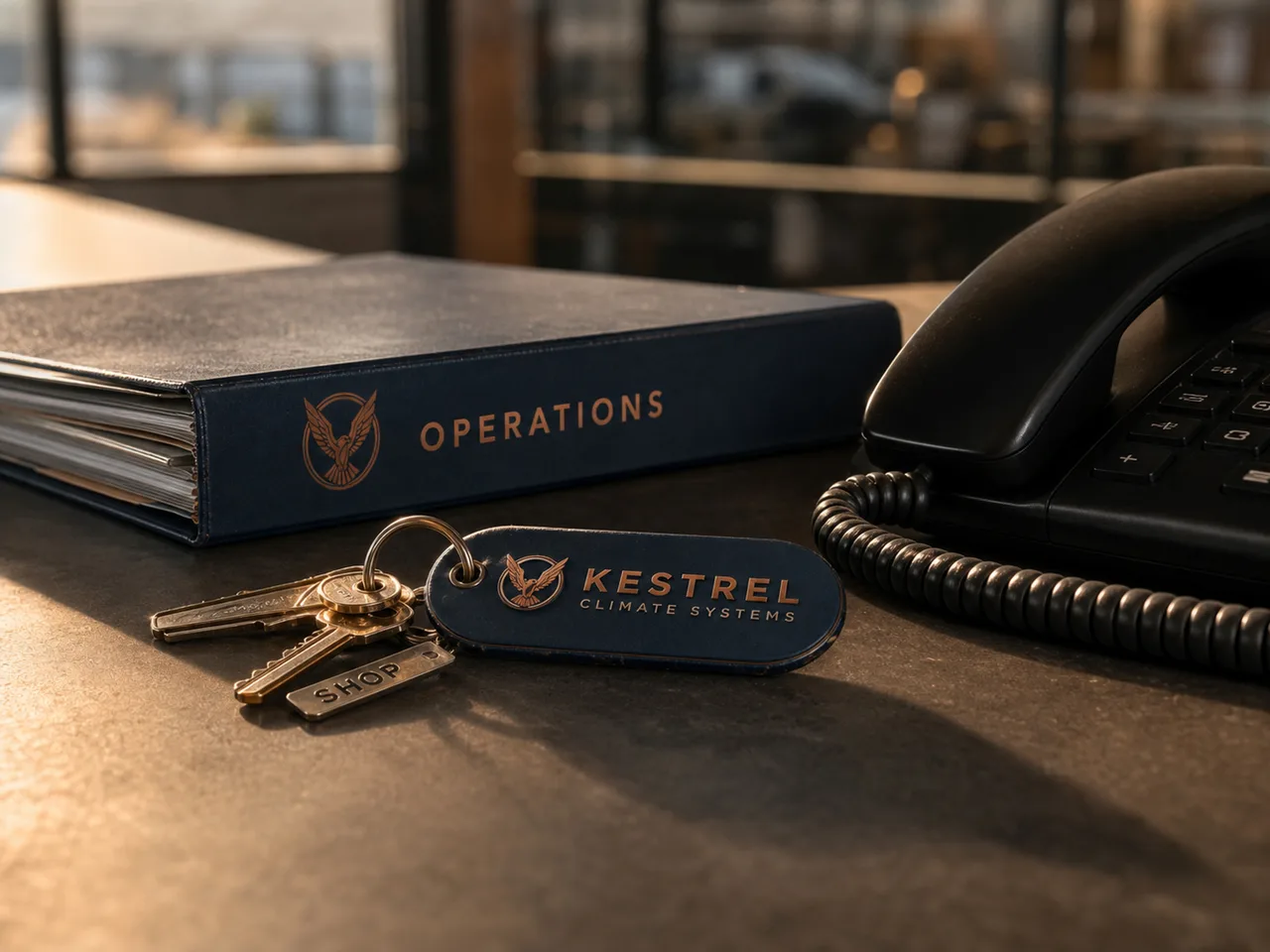
The operations binder and the shop keys
The walk-through: relationships handed over in person
The roadmap, stage by stage
Five stages, from the work before closing to independent operation. Select a stage: each card shows what happens, who leads it, the owner's part, and what it depends on.
The quiet stage that decides how clean day one feels. While the papers move, the seller assembles every consent on the confirmation list, builds the systems and access inventory with the buyer's counsel, and starts the licensing path the chosen structure requires.
What happens
Consents assembled, buyer's Technical Safety BC licences and surety bond in progress (asset sale) or continuity filings prepared (share sale), systems inventory and access list built, WorkSafeBC clearance letter obtained
Who leads
Seller with buyer's counsel
The owner's part
High
The outcome
Clean day-one transfer
Depends on
Landlord and contract consents arriving on time; the share or asset decision, which sets the licensing path
Still open
Landlord and contract consents
Requires confirmation
The team hears it together, from both owners in the same room, on day one. Customers see no change: the phones answer the same, the vans roll the same, and the week runs as dispatched.
What happens
Team told together, customer-facing continuity, accounts and phones transferred, banking live
Who leads
Both
The owner's part
Full-time
The outcome
Business runs without interruption
Depends on
New bank and merchant accounts open and tested before closing day; on an asset sale, the buyer's licences and bond already in hand
Still open
Nothing open at this stage
The relationship month. The owner leads sit-down introductions to the top 20 commercial accounts and the supplier branches, rides along on service days, and walks the buyer through how work is priced.
The owner's full time availability, and customer calendars for the in-person introductions
Still open
Nothing open at this stage
The writing-down stage. The two knowledge gaps this package names in the open, commercial contract pricing and the membership renewal cadence, get documented with the buyer in working sessions, against live quotes.
What happens
Commercial pricing playbook written with the buyer, quoting shadowed, membership renewal cadence documented
Who leads
Owner and buyer
The owner's part
Tapering to two days a week
The outcome
Owner knowledge on paper
Depends on
Live quoting to shadow through the period, and the working sessions holding their place in the calendar
Still open
Nothing open at this stage
The letting go. The buyer leads and the owner answers the phone. Seasonal planning for the summer peak happens together once, then the advisory cadence winds down toward independent operation.
What happens
Advisory calls, seasonal planning for the summer peak, escalation support
Who leads
Buyer leads
The owner's part
On-call
Proposed
The outcome
Independent operation
Depends on
Advisory terms agreed in the purchase agreement, one of the four open negotiation terms
Still open
Advisory terms
Requires confirmation
The handover, layer by layer
01The owner's role todayWhat sits with the seller today, mapped before any of it moves
Operating
Final pricing on installations over $15,000, and the escalations that clear the Service Manager. The daily flow, booking through collection, already runs without the owner.
Financial
Banking authority and the final look at the books. The Office Manager runs entry, receivables and payroll day to day; month end oversight sits with the part time bookkeeper, whose role ends at closing.
Customers
The top 20 commercial relationships are personal. The largest, 4.6% of revenue on a 12 year relationship, renews March 2027 and is introduced in week one.
Suppliers
Trading terms and the volume pricing tier with the largest distributor, 41% of materials, negotiated by the owner. The tier moves with a consent letter.
Employees
Day to day the crew answers to the Service Manager. The owner decides, with the buyer, how and when the team is told: the plan is together, at closing.
Strategic
Commercial contract pricing lives in the owner's head, and seasonal planning for the summer peak is the annual rhythm. Both are named training subjects with dates on the roadmap.
02Training and knowledge transferFive subjects, taught side by side, then written down
Commercial pricingSupplier negotiationTechnical Safety BC compliance rhythmRefrigerant log disciplineSeasonal planning
Who teaches
The owner, side by side through the full time weeks. Field standards need no teaching: the documented checklists carry them, and the Service Manager holds the quality bar.
How it happens
Introductions and ride-alongs first, then shadowed quoting, then working sessions that write the pricing playbook and the renewal cadence down with the buyer.
How long
Across the 8 full time weeks, finishing through the taper to month 6. Proposed
The intended result
A buyer who prices, buys and plans without the owner, holding documents that did not exist before the handover.
The pricing knowledge is the owner's to hand over, and days 31 to 90 write it down with the buyer. Senior diagnostic knowledge stays with the team it lives in; the apprentice pipeline is how it spreads.
03Team continuityReferenced, not repeated: the full roster lives under Team
Employees have not been told about the potential sale, and nothing in this package is a commitment by any employee. What transition planning needs to know:
Employment carries on. Under BC employment standards, employment is generally treated as continuous through a sale, so tenure and its entitlements carry to the buyer.
Buyer due diligence required
The licences stay workable. The Service Manager holds the qualifications and the named mechanic role both company licences lean on, and can hold dispatch and quality control from day one.
One role ends by design. The part time bookkeeping by the owner's spouse ends at closing, replaced by an outside bookkeeper at about $10,000 a year.
04Relationships and accountsWho gets introduced, what needs consent, what opens new
Relationship or account
What it needs
How it moves
Top 20 commercial customersthe top 10 alone are 18.3% of revenue
Introduction
Sit-down introductions across weeks 1 to 8, owner led. The largest account, 4.6% of revenue and renewing March 2027, is introduced in week one.
Supplier accounts41% of materials with the largest distributor
Consent letter
The volume pricing tier moves with a consent letter; branch introductions happen in the first 30 days. No exclusivity anywhere.
The landlordlease to October 2027 plus a five year option
Consent
Assignment and change of control need landlord consent, not to be unreasonably withheld. The consent letter is assembled before closing.
Commercial maintenance contracts52 active
Consent on 7
41 transfer as written, 7 need the customer's consent, and 4 carry clauses for counsel to read before closing.
Residential memberships240 active
Transfer
Move with the business; no consents involved.
Fleet tracking (Geotab)36 month contract to May 2027
Assignment
Assigned to the buyer with the provider's consent; the Service Manager runs it today.
Bank and merchant accounts
New accounts
Opened new by the buyer and tested before closing, so payment rails are live in week one.
Insurancegeneral liability and fleet
New policies
The buyer places its own policies at closing; both current policies renew each March.
WorkSafeBCclearance letter before closing
Clearance letter
Fresh registration at the base rate on an asset sale; on a share sale the account and its experience rating continue.
Technical Safety BCgas and refrigeration licences
Licensing path
New licences, quality control program, named mechanic and surety bond on an asset sale; continuity filings on a share sale. The Service Manager qualifies as the named mechanic.
Every consent here also sits in the confirmation list at the top of this section. This table is where each one lands, and who moves it.
05Assets, systems and accessEvery account, key and register, inventoried before closing
The before closing stage builds a single systems and access inventory with the buyer's counsel. This is what it covers, and how each item moves. Passwords and credentials never appear in this package; access changes hands at closing, through the inventory.
Jobber, QuickBooks and PayworksAccount transfers supported; admin handover at closing. The accountant keeps the working papers.
Google Workspace and the domainEmail, calendars and drive move with the business.
Phone numbersMove with the business; answered the same on day one.
Website and review profilesDomains, hosting and the Google Business Profile transfer with the business.
Fleet trackingGeotab contract assigned with provider consent.
Load calculation softwareLicence reassigned to the buyer.
Keys, codes and the alarmHanded over at closing against the access inventory.
Bank and merchant accountsOpened new by the buyer; live before week one.
Licences, bond and registersPer the licensing path; the refrigerant logs and approved person register, kept 36 months as required, transfer with the records.
Operating documentsDispatch protocol, install and commissioning checklists, maintenance checklists and the safety program, all documented and transferring as written.
Vehicles, equipment and inventory are itemized under Operations with values, and the systems above are tabled there with costs and contract terms. This layer is about access: who can get in, and when that changes.
06Risks and open itemsNamed plainly, with what answers each one
Owner-held relationshipsThe top 10 customers are 18.3% of revenue
The 8 week introduction plan, the Service Manager's continuity, and a 96% commercial renewal history.
Knowledge not yet on paperCommercial pricing and the membership cadence live with the owner today
Working sessions in days 31 to 90 write both down with the buyer, against live quotes.
Employee retentionEmployees have not been told; nothing here is a commitment by any employee
Told together at closing. Average tenure is 7.9 years, employment carries on under BC standards, and wages sitting modestly below market is the one watch item, with a driver for it in Forecasts.
The senior technician, 61One of four service technicians; retirement possible within 2 to 3 years
The apprentice pipeline, an open posting since June 2026, and documented diagnostics checklists.
Licensing at closingOn an asset sale the buyer needs its own licences and bond before operating
The Service Manager holds the qualifications and the named mechanic role; filings begin before closing, and a share sale continues everything.
Third party consentsOne lease, seven contract consents and a GPS assignment sit between signing and closing
Assembled in the before closing stage, led by the seller with the buyer's counsel.
The full risk register, the market items included, sits under Diligence. These six are the ones the handover itself must answer.
The intended outcome
What a finished handover leaves you holding
Operational control. The board, the crew and the quality bar answer to you, run day to day by the Service Manager.
Systems and access. Every account, key, code and register transferred against the inventory, working.
The money processes. Invoicing, collections, payroll and month end, understood and running.
The relationships. The top 20 accounts and the supply chain, introduced in person on their own sites.
The team. Duties, pay and continuity clear, role by role.
Independence. The owner reachable on advisory terms, and not needed for the routine week.
That is the standard the roadmap is built backwards from. None of it is promised on its own; it is what the stages, the labels and the open items are all pointed at.
09
09Data room
Every number here has a paper trail
What a careful buyer will ask, the proof already on the table, and the thirty documents waiting behind the door. This section ends at the room where you read them all.
Step 01 · The questions
What a careful buyer will ask, answered first
Seven things any serious buyer's accountant raises in the first week. Each one is here already, with its size and what stands against it. Open the ones you care about.
01Owner relationships with top-20 commercial accountsTop 10 customers are 18.3% of revenue
The size of it
Top 10 customers are 18.3% of revenue
What stands against it
8-week introduction plan; Service Manager continuity; 96% commercial renewal history
02Senior technician age 61 may retire within 2 to 3 yearsOne of four service technicians
The size of it
One of four service technicians
What stands against it
Apprentice pipeline, open posting, documented diagnostics checklists
03Field wages sit modestly below Okanagan mediansWage reviews likely; roughly $25,000 to $40,000 a year to reach medians across the field team
The size of it
Wage reviews likely; roughly $25,000 to $40,000 a year to reach medians across the field team
What stands against it
Tenure and benefits carry retention today; scenario model carries a wage-growth driver for exactly this
04Largest customer contract renews March 20274.6% of revenue
The size of it
4.6% of revenue
What stands against it
12-year relationship; renewal history; introduction in week one
05Licensing transition at closingOn an asset sale the buyer needs its own gas and refrigeration licences and bond before operating
The size of it
On an asset sale the buyer needs its own gas and refrigeration licences and bond before operating
What stands against it
Service Manager holds the qualifications and the named-mechanic role; filings begin before closing; a share sale continues everything
06Refrigerant transition (new low-GWP equipment)About $9,000 equipment by 2027
The size of it
About $9,000 equipment by 2027
What stands against it
Two stations already compatible; normal course capex
07Seasonal cash thinning in March and AprilMarch operating profit about $4,300
The size of it
March operating profit about $4,300
What stands against it
Membership billing smooths cash; $75,000 line of credit available and unused
The door is at the end of this section. Access opens after a Senior Deal Advisor calls you.
The record, shelved and labelled
Step 02 · Proof already on the table
Four records this package publishes before anyone asks: the filed tax record, six years of capital spending, the WorkSafeBC file and who prepared the numbers.
Income tax, three years filedfiled and paid, nothing in dispute
Year
Income for tax
Rate
Tax
2023
$231,900
11%
$25,509
2024
$261,800
11%
$28,798
2025
$300,700
11%
$33,077
Income for tax purposes differs from reported operating profit through capital cost allowance and small timing items. Combined federal small business (9%) and BC (2%) rate of 11% applied on active business income within the $500,000 business limit. With a December 31 year end, balances are due March 31 and returns June 30; filed and paid, no amounts in dispute. Notices of assessment were received as filed for all three years, and T2 Schedule 141 reports that a compilation engagement was conducted (line 302).
Capital spending, six years9 purchases on the record
2020 · Isuzu NPR box truck$58,000
2021 · Ford Transit 250 service van$44,000
2021 · Ford F-150$47,500
2022 · Ram ProMaster 2500 (financed over 60 months)$54,000
2023 · Press tool system$7,400
2023 · Brazing set upgrade$6,200
2024 · Ford Transit 250 high roof service van$61,000
2024 · Refrigerant recovery station$22,000
2025 · Combustion analyzers and diagnostics refresh$4,300
WorkSafeBCclean record, rates below base
Standing
Account in good standing; clearance letter available on request (the clearance date is in the text of the letter, not the letter's date)
Claims
Zero lost-time claims in the last five years; two minor first-aid entries in 2024
Rates
Net rate $1.94 per $100 of payroll in 2025 against a $2.06 base, earned by the clean record; the 2026 base is $2.26. Classification 721043: plumbing, heating, vent, residential air conditioning installation or repair.
On a share sale the experience rating follows the company; on an asset sale to an unaffiliated buyer it generally does not, and the buyer starts at the base rate. Assets of a firm owing WorkSafeBC can carry a statutory lien, which is why the clearance letter comes before closing.
The accountant, and the reputationOkanagan Ridge CPA, Chartered Professional Accountants (fictional firm)
Prepared by
Okanagan Ridge CPA, Chartered Professional Accountants (fictional firm), Kelowna, BC
Engagement
Compilation engagement under Canadian Standard on Related Services (CSRS) 4200; no audit, no review, no assurance expressed
Reputation
4.9 stars across roughly 640 reviews (fictional)
The basis of accounting applied in the preparation of the balance sheet of Kestrel Climate Systems Ltd. and the statement of income for the year then ended is on the historical cost basis and reflects cash transactions with the addition of: accounts receivable less an allowance for doubtful accounts; inventory valued at the lower of cost and net realizable value; prepaid expenses; property, plant and equipment amortized on a declining balance basis over their estimated useful lives; accounts payable and accrued liabilities; deferred membership revenue; and revenue recognized on the accrual basis as work is completed.
Step 03 · Inside the room: thirty documents
This is the room's own index. Open a category to see its files. Every title is a real file, held privately under the company's name.
Financial records7
Compiled financial information, year ended December 31, 2025
Compiled financial information, year ended December 31, 2024
Compiled financial information, year ended December 31, 2023
Monthly income detail, fiscal 2025
Seller's discretionary earnings schedule, 2023 to 2025
Accounts receivable aging, December 31, 2025
Equipment and vehicle purchase history, 2020 to 2025
Corporate and tax5
Corporate tax filing summary, 2025
Corporate tax filing summary, 2024
Corporate tax filing summary, 2023
Corporate profile and share structure
Encumbrances and change-of-control summary
Lease and premises1
Premises lease abstract
Employees3
Employment structure and role summary
Employment agreement template
Organization chart and responsibility matrix
Customers and agreements3
Memberships and commercial contracts register, anonymized
Membership and commercial contract templates
Significant customer relationships, anonymized
Suppliers1
Supplier arrangements and terms
Assets and equipment3
Vehicle fleet register
Equipment and tool register
Inventory summary at cost
Insurance, licences and compliance4
Insurance coverage summary
Licences, certifications, bond and safety record
WorkSafeBC classification, rates and standing
Refrigerant compliance file: approved persons and service logs
Operations and transition3
Process documentation index
Marketing performance summary, 2025
Transition and training plan detail
The door is directly below. Access opens after a Senior Deal Advisor calls you.30 files · 9 categories
Succession Market
The data room
Behind this package sits a private data room: the owner's statements, returns, contracts and equipment records, held under the company's own name on Succession Market.
30 documents inside
A demonstration, open to anyone
On a real package, every open of every file logged
If this reads like the business you came looking for, the room is the next step: the source documents, your own questions, and a decision made with everything in front of you.
A Senior Deal Advisor calls you before access opens.
Your request is in.
A Senior Deal Advisor will call you to confirm who you are. Access opens after the call.